Engineering Precision Space Solar Array Simulation: Principles & Physics
In satellite electrical power subsystem (EPS) development, verifying how the spacecraft bus interacts with photovoltaic panels is one of the most critical risk-mitigation steps prior to launch. A Space Solar Array Simulator (SAS) is not merely a high-performance programmable DC power supply; it is an engineered test instrument capable of reproducing the complex, highly non-linear output characteristics of space-grade multi-junction solar cells (such as Triple-Junction InGaP/InGaAs/Ge or Quad-Junction GaAs cells) across extreme orbital environments.
When operating in orbit, solar panels undergo drastic electrical transitions due to spinning satellite dynamics, orbital eclipse entries and exits, albedo reflection, ionizing radiation degradation, and temperature swings ranging from -120°C to +140°C. Standard DC power supplies fail in this test environment because their large output filter capacitors introduce phase lag and artificial energy storage, which can disrupt spacecraft Maximum Power Point Tracking (MPPT) regulators or Direct Energy Transfer (DET) sequential shunt limiters.
Semantic Search & E-E-A-T Key Insight: Dynamic Impedance Emulation
Unlike terrestrial photovoltaic panels, space solar arrays exhibit high dynamic impedance and near-instantaneous current changes when entering or exiting eclipse conditions. AMETEK's space solar array simulators utilize hardware-calculated algorithm engines paired with low output capacitance power stages to maintain loop stability under fast dI/dt dynamic loads.
AMETEK Programmable Power—through its world-renowned Elgar and Sorensen product lineages—has pioneered space SAS technology for over four decades. Our simulators provide specialized analog and high-speed digital control loops that continuously update the output I-V curve at hardware speeds. This ensures that when a spacecraft's power management and distribution unit (PMAD) sweeps the array voltage to locate the peak power point, the simulator responds precisely along the programmed non-linear curve without ringing, overshooting, or triggering false over-voltage protection circuits.
Core Technical Capabilities of AMETEK Space SAS Platforms
Global aerospace test engineers and procurement specialists evaluate Space Solar Array Simulators based on fidelity, bandwidth, software flexibility, and hardware longevity. Below are the key architectural cornerstones embedded into AMETEK's SAS engineering matrix:
Ultra-Low Output Capacitance
Designed with specialized output filters, minimizing internal capacitance to prevent energy discharge into spacecraft shunt switches, preserving real-world dynamic impedance response.
Fast Hardware I-V Generation
Real-time mathematical curve engines compute the exact exponential solar diode equation in hardware, guaranteeing seamless transitions between Constant Voltage (CV), MPPT, and Constant Current (CC) zones.
Eclipse & Orbit Profiling
Pre-program complex orbital profiles simulating low Earth orbit (LEO) fast eclipse cycles, geostationary (GEO) seasonal variations, and spinning satellite solar vector shifts.
Multi-Channel High Density
Modular rack designs support dozens of isolated channels, allowing individual simulation of separate solar panel segments, wings, or multi-string arrays within a compact footprint.
Spacecraft Bus Protection
Hardware-enforced Over-Voltage Protection (OVP) and Over-Current Protection (OCP) prevent costly flight-hardware damage during automated test execution (ATE).
Comprehensive ATE Automation
Fully compliant with SCPI, Ethernet, GPIB, and LabVIEW drivers, integrating effortlessly into hardware-in-the-loop (HIL) automated test benches.
Technical Specification Comparison: Space SAS Product Lines
To assist aerospace procurement leads and test lab directors in selecting the optimal platform, the following table highlights baseline operational parameters for AMETEK's flagship solar array simulation systems:
| Feature / Parameter |
Elgar m-SAS Series |
TerraSAS ETS Series |
ASPS Advanced Series |
| Primary Application |
SmallSat, CubeSat & Multi-Channel LEO EPS Test |
Large Satellite Subsystem & HIL Verification |
High-Power Spacecraft & Terrestrial PV Sim |
| Max Channel Voltage |
Up to 150 VDC per channel |
Up to 1000 VDC per channel |
Up to 600 VDC per channel |
| Current Output per Channel |
Up to 10 A (Modular scaling) |
Up to 15 A / 30 A options |
Configurable up to 50 A+ |
| Curve Update Frequency |
Hardware real-time (< 10 µs) |
DSP Fast Update Loop (< 25 µs) |
Real-time Digital Calculation |
| Form Factor / Density |
Ultra-dense 3U multi-channel chassis |
Modular Standalone / Rackmount |
Integrated High-Power Cabinet |
| Control Software |
SAS Control GUI & SCPI API |
TerraSAS Software Suite |
Advanced System Software Suite |
Enterprise Product Recommendations for Space Power Testing
AMETEK Programmable Power engineers custom and off-the-shelf solar array simulators trusted by prime aerospace defense contractors, space agencies (NASA, ESA, JAXA), and commercial space pioneers. Below are our primary recommendations for space array emulation:
SmallSat & CubeSat Flagship
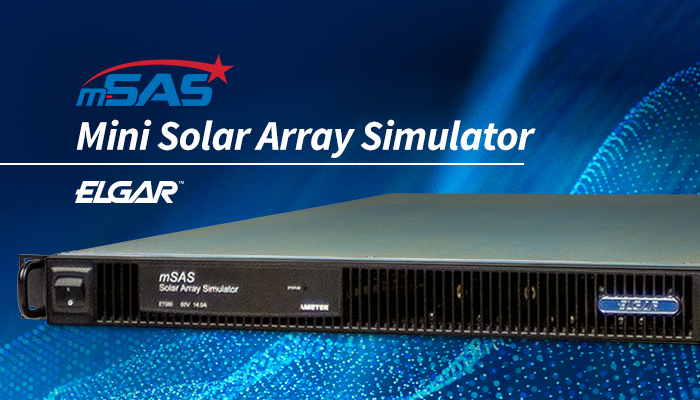
Elgar m-SAS (Modular Space Solar Array Simulator)
The Elgar m-SAS is built specifically to address the rigorous requirements of modern SmallSat and micro-satellite power subsystems. Featuring localized curve generation hardware per channel, ultra-low output capacitance, and remarkable power density, the m-SAS enables testing of up to 8 independent solar panel strings in a single rack-mountable chassis. It is the premier choice for fast-paced constellation validation schedules.
Get Catalog
High-Power Satellite Subsystems
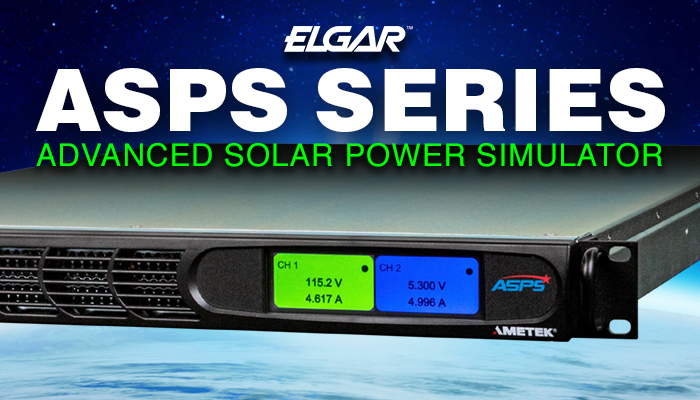
ASPS (Advanced Solar Power Simulator) Series
Designed for GEO communication satellites, deep space probes, and high-wattage spacecraft buses, the ASPS Series delivers uncompromising fidelity at elevated power levels. Featuring dual-channel capabilities and advanced thermal/radiation degradation modeling engines, the ASPS platform simulates multi-junction GaAs solar arrays under complex spinning, shadowing, and eclipse transition dynamics with microsecond loop response times.
Get Catalog
Custom Engineered Test Racks
Integrated Rack-Level Solar Array Simulation ATE
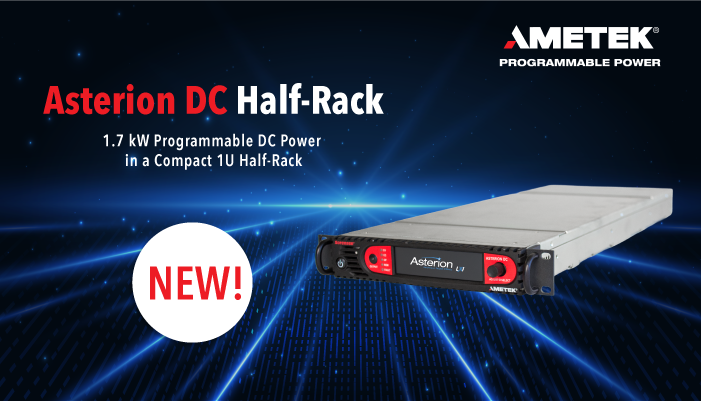
For large-scale spacecraft integration facilities, AMETEK provides fully customized turnkey ATE racks. Integrating Asterion DC power units, Elgar SAS modules, matrix switching, calibration units, and emergency shutdown safety circuits, these engineered systems provide complete end-to-end EPS qualification capabilities in one integrated footprint.
Get Catalog
Request the Official AMETEK Space Solar Array Simulator Catalog
Access detailed technical schematics, software integration manuals, curve-engine formulas, and ordering guides for our complete range of space-qualified solar array simulation hardware.
Get Catalog
Strategic Procurement Trends in Global Space Hardware Verification
The space industry is undergoing a historic shift driven by Commercial Space ("Space 2.0"), mega-constellations in Low Earth Orbit (LEO), and renewed lunar exploration programs (Artemis initiative). As satellite manufacturing transitions from low-volume bespoke spacecraft to serialized production lines, procurement teams face evolving challenges in power test infrastructure:
1. Transition from Custom One-Off Test Fixtures to Modular COTS Platforms
Historically, satellite primes constructed proprietary solar array simulation test boxes for every unique mission. Today, procurement officers prioritize Commercial Off-The-Shelf (COTS) modularity. Standardized SAS architectures—like the Elgar m-SAS—allow test engineering teams to reconfigure voltage/current profiles via software rather than rebuilding hardware infrastructure, reducing procurement lead times from months to weeks.
2. Scalability for LEO Mega-Constellation Assembly, Integration, and Testing (AIT)
Constellations comprising hundreds or thousands of satellites require rapid AIT workflows. Procurement strategies now mandate automated, multi-channel test racks capable of parallel testing multiple satellite buses simultaneously. Key buyer metrics include maximum channels per rack meter, remote Ethernet monitoring, and automated self-calibration.
3. Hardware-in-the-Loop (HIL) & Digital Twin Synchronization
Modern satellite developers combine hardware testing with high-fidelity digital twins. Space Solar Array Simulators must seamlessly interface with real-time simulation environments (such as MATLAB/Simulink or dSPACE). AMETEK SAS platforms provide low-latency communication bus options, enabling dynamic orbital trajectory feeds to modify solar irradiance and panel temperatures in real time during HIL simulation cycles.
4. Risk Mitigation against Flight Hardware Damage
Spacecraft power management units contain delicate flight electronics. Procurement teams scrutinize safety interlocks, back-power protection, and over-voltage response times. An SAS instrument must guarantee that an unexpected software lockup will never dump destructive energy levels into an un-launched satellite bus.
Technological Roadmaps & Future Innovations in Solar Array Simulation
To keep pace with advanced solar cell chemistries and higher-voltage spacecraft architectures, space solar array simulation technology continues to evolve rapidly. Key technological trends shaping future SAS designs include:
Wide-Bandgap Semiconductor Power Stages (GaN & SiC)
The integration of Silicon Carbide (SiC) and Gallium Nitride (GaN) switching devices into SAS internal power topologies enables substantially higher switching frequencies. This translates to smaller magnetic components, drastically reduced internal capacitance, higher thermal efficiency, and overall rack-space reduction while enhancing dynamic loop bandwidth.
Emulation of Advanced Multi-Junction and Flexible Solar Panels
Next-generation space missions are adopting quad-junction and perovskite-on-silicon tandem solar cells, as well as ultra-flexible deployable arrays (such as ROSA - Roll-Out Solar Arrays). These technologies exhibit complex reverse-bias breakdown curves, localized shading behavior, and micro-crack impedance variations. Advanced SAS algorithms are moving beyond the classical single-diode model to multi-diode physical models computed live in FPGA hardware.
Higher Voltage Spacecraft Buses (120 V - 300 V DC)
To reduce copper weight in high-power electric propulsion (EP) satellites and manned space platforms, spacecraft bus voltages are increasing from traditional 28 V DC levels to 120 V, 160 V, and up to 300 V DC. Modern Space SAS systems are engineered with isolation barriers and wide autoranging voltage outputs to support these elevated operating voltages cleanly and safely.
Why Global Aerospace Leaders Partner with AMETEK Programmable Power
When selecting a supplier for space solar array simulation, technical heritage and organization trustworthiness (E-E-A-T) are paramount. AMETEK Programmable Power stands as an industry benchmark for several foundational reasons:
- Unmatched Aerospace Heritage: For over 50 years, the Elgar, Sorensen, and California Instruments brands have provided power solutions for flagship missions including space stations, lunar landers, deep space probes, and commercial communication satellites.
- AS9100 & ISO 9001 Certified Manufacturing: Our San Diego design and manufacturing facilities adhere to stringent aerospace quality management standards, ensuring long-term reliability and strict trace-ability.
- Global Calibration & Technical Support: Through our exclusive service partnerships—including our worldwide distribution and calibration alliance with Transcat—we provide certified, NIST-traceable calibration and technical support anywhere on the globe.
- Comprehensive Application Engineering Support: Our team of expert power electronics engineers assists space clients with custom curve algorithm scripting, ATE rack integration, and specialized load-line stability analysis.
Frequently Asked Questions (FAQ) — Space Solar Array Simulators
Below are authoritative answers to questions frequently asked by space systems engineers, satellite project leads, and aerospace procurement professionals during system evaluation:
What is a Space Solar Array Simulator (SAS) and how does it differ from a standard programmable DC power supply?
A Space Solar Array Simulator (SAS) is a highly specialized instrument engineered to replicate the precise, non-linear Current-Voltage (I-V) dynamic curve of space photovoltaic panels. Unlike standard programmable DC power supplies—which function as constant voltage or current sources with high output filter capacitance—an SAS possesses ultra-low output capacitance and ultra-fast hardware control loops. This allows the simulator to rapidly shift between constant voltage, maximum power point (MPP), and constant current regions without phase lag or instability, accurately simulating space array behavior when interacting with spacecraft MPPT regulators and shunt limiters.
Why is dynamic output capacitance a critical metric when choosing a Space SAS?
Spacecraft Power Management and Distribution (PMAD) units often employ high-frequency switching regulators or pulse-width modulated (PWM) shunts to manage solar power. High output capacitance inside a power supply stores excessive energy; when a spacecraft shunt turns on, this capacitance dumps energy rapidly into the flight switch, potentially destroying hardware or distorting the dynamic I-V curve. AMETEK Space SAS systems feature specialized low-capacitance output filters to preserve dynamic load impedance and ensure safe, true-to-life testing.
How does dynamic MPPT tracking frequency impact satellite peak power tracking evaluation?
Satellite MPPT controllers continuously perturb the operating voltage to maximize power output. If the simulator's internal curve engine cannot recalculate output parameters faster than the MPPT tracking frequency (often several kilohertz), the controller will track an invalid point, yielding inaccurate tracking efficiency measurements. AMETEK SAS platforms utilize hardware FPGA-driven curve engines with loop update rates under 10 microseconds, ensuring precision tracking efficiency verification.
Can AMETEK Space SAS handle modern multi-junction (GaAs) solar panel characterization?
Yes. AMETEK software engines enable engineers to program multi-junction Gallium Arsenide (GaAs) parameters, including short-circuit current (Isc), open-circuit voltage (Voc), maximum power current (Imp), maximum power voltage (Vmp), fill factor, and temperature coefficients. Furthermore, users can upload custom multi-point empirical curve files derived from actual solar cell flash-lamp laboratory testing.
How does the m-SAS system accommodate low Earth orbit (LEO) eclipse transition simulation?
The Elgar m-SAS allows engineers to store pre-programmed orbital profiles containing continuous irradiance and temperature curves. During a simulated 90-minute LEO orbit, the m-SAS smoothly transitions from total darkness (eclipse) to full sun ambient exposure within seconds, executing controlled ramp profiles that simulate the exact thermal-electrical transition experienced by solar arrays coming out of the Earth's shadow.
What software interfaces and ATE drivers are supported for automated test environments?
AMETEK Space SAS hardware supports standard SCPI command sets over Ethernet (LXI), GPIB, and USB interfaces. Native IVI drivers and comprehensive LabVIEW software packages are supplied, making it simple to incorporate the simulator into custom Python, C++, or National Instruments-based automated test benches.
Equip Your Space Program with Certified Power Simulation
Whether you are designing a CubeSat constellation, qualifying a GEO communications satellite, or building automated ATE racks for deep space payload integration, AMETEK Programmable Power offers field-proven Space Solar Array Simulators to guarantee mission success.