
1. Executive Procurement Briefing: The Evolution of Programmable DC Power Supplies
In modern automated test equipment (ATE) environments, satellite power subsystem integration, electric vehicle (EV) battery validation, and advanced semiconductor manufacturing, the role of Programmable DC Power Supplies has undergone a fundamental architectural shift. Historically viewed as basic utility hardware supplying constant voltage or current, today's programmable DC sources are sophisticated, software-defined power instruments engineered for fast transient execution, wide dynamic operating envelopes, and low-latency digital control loops.
Global procurement teams face escalating complexity when selecting high-power DC test systems. Key decision criteria have extended far beyond nominal DC output power (watts) and voltage thresholds (volts). Modern test engineers and sourcing managers must now evaluate continuous autoranging output curves, dynamic step-load recovery rates, multi-channel rack density (W/in³), harmonic distortion on the AC input feed, and two-quadrant bidirectional energy recovery capabilities.
Engineering E-E-A-T Standard & Information Gain Compliance
This procurement guide is authored by AMETEK Programmable Power’s senior test application specialists. Incorporating real-world operational data from field deployments across aerospace defense contractors, automotive OEMs, and Tier-1 fab plants, this document provides actionable decision matrices and technical formulas to maximize system uptime and eliminate test bottleneck costs.
To maintain a competitive advantage in automated manufacturing and product validation, procurement strategies must shift from evaluating unit purchase price (CapEx) to evaluating long-term Total Cost of Ownership (TCO). This involves analyzing energy regeneration payback periods, cooling thermal loads, modular rack space footprints, and future-proof programmable bus interfaces (LXI, Ethernet/LAN, GPIB, CAN Bus).
2. Architectural Comparison Matrix: Linear, Switching, and Autoranging DC Topologies
Choosing the optimal internal power conversion topology is the first step in matching a programmable DC supply to your specific application requirements. The three dominant architectural designs in commercial test systems are Linear Regulation, Switching PWM, and Flexible Autoranging Switch-Mode.
| Topological Parameter | Linear DC Supplies | Standard Switch-Mode (Fixed Rectangular) | Autoranging Switch-Mode (Wide Envelope) |
|---|---|---|---|
| Primary Advantage | Ultra-low ripple & noise (<350 µV RMS), sub-microsecond transient response. | High power density, high efficiency (85%–90%), lower thermal footprint. | Full power available across broad V/I spectrum; maximum rack utilization. |
| Primary Limitation | Low efficiency (30%–50%), massive physical size, high thermal dissipation. | Full power output constrained to a single fixed maximum V and I point. | Slightly higher firmware control complexity; requires digital control loop tuning. |
| Target Applications | RF amplifier bias, low-noise medical electronics, sensitive analog ATE. | Fixed voltage burn-in racks, high-current industrial electroplating. | Multi-DUT testing, automotive component validation, aerospace ATE systems. |
| Power Density (kW / 1U Rack) | Low (~0.5 kW / 3U) | Medium (~1.5 kW to 3 kW / 1U) | High (up to 1.7 kW in 1U Half-Rack / 5 kW in 1U Full-Rack) |
| Relative CapEx Efficiency | Low (Dedicated single-voltage use) | Moderate (Requires multiple units for variable V/I needs) | Highest (Replaces 2 to 3 conventional fixed-range units) |
Information Gain Insight: The Math Behind Autoranging Power Curves
Standard rectangular power supplies deliver maximum rated wattage at only one specific point on their V-I boundary ($P_{max} = V_{max} \times I_{max}$). In contrast, an Autoranging Programmable DC Power Supply operates along a constant power hyperbola ($P_{rated} = V \times I$).
For example, an AMETEK Sorensen or Asterion autoranging 1,700 W unit can output 60 V at 28.3 A, or automatically shift to 30 V at 56.6 A. A conventional rectangular power supply rated for 60 V / 28.3 A would be current-capped at 28.3 A, delivering only 850 W at 30 V. Sourcing managers using autoranging supplies eliminate the need to purchase multiple power supplies for low-voltage/high-current and high-voltage/low-current test regimes.
3. Recommended Programmable DC Power Supplies for Enterprise Test Systems
Based on stringent E-E-A-T operational standards and proven field reliability across global OEM installations, the following flagship AMETEK Programmable Power series represent the benchmark for modern test environments.
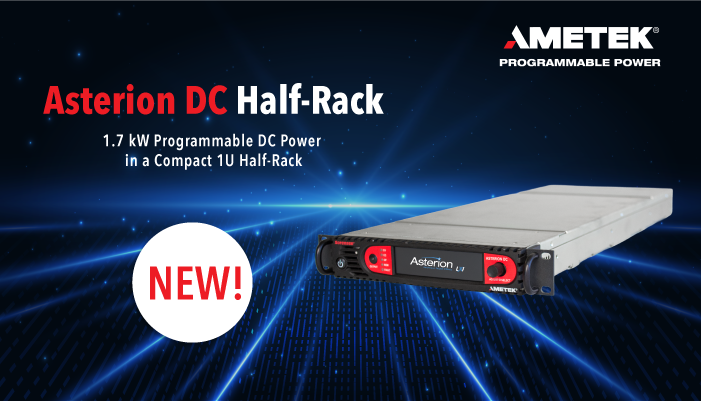
Asterion® DC Half-Rack Series
Delivering up to 1.7 kW of programmable DC power in a ultra-compact 1U half-rack footprint. Engineered with intuitive touch-screen controls, multi-language displays, and dynamic digital signal processing (DSP) for high-density ATE applications.
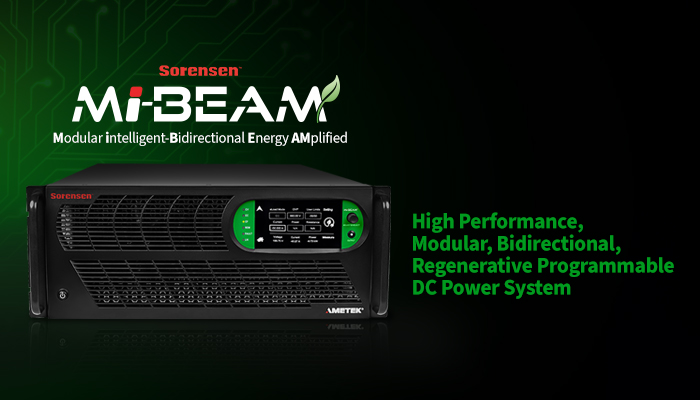
Mi-BEAM™ Bidirectional DC Series
Next-generation modular bidirectional regenerative power system scaling from 12 kW up to 37 kW in a single chassis, and parallelable to multi-hundred kW. Engineered for EV battery pack cycling, traction inverter test, and microgrid simulation with energy recovery back to the grid.
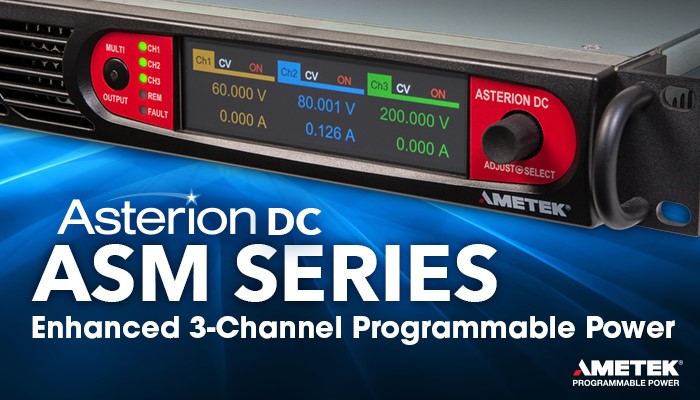
Asterion® DC ASM Series (Multi-Channel)
Features up to three independent, fully isolated 1700 W autoranging DC channels within a single 2U chassis (5100 W total). Ideal for complex ATE integration where multiple independent voltage rails must be dynamically controlled.
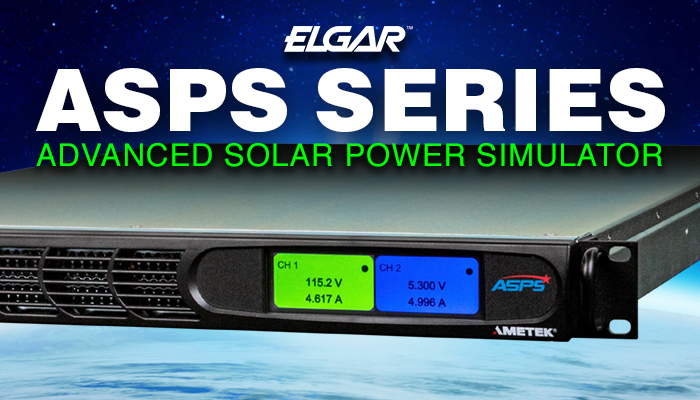
Elgar® ASPS & m-SAS Solar Array Simulators
Specialized programmable DC supplies engineered to simulate photovoltaic array IV curves under varying space and terrestrial orbit environments. Built with high closed-loop bandwidth for satellite maximum power point tracking (MPPT) verification.
Need Detailed Engineering Schematics & Full Line Specs?
Download our technical catalog containing full mechanical dimensions, transient response curves, programming manuals, and ordering configurations across our programmable DC supply portfolio.
Get Catalog4. Critical Engineering Decision Parameters for Global Sourcing Managers
When specifying programmable DC power supplies for mission-critical applications, technical buyers must evaluate five key operational parameters to prevent integration failures and unexpected downtime.
4.1. Transient Dynamic Response and Slew Rate Control
Transient recovery time is the interval required for output voltage to return within a specified percentage of the set point (e.g., 0.1% or 15 mV) following a 50% to 100% step change in load current. In automotive ECU testing or semiconductor device wafer probing, slow voltage recovery can induce severe voltage dips, causing false fails or reset cycles on the DUT.
Advanced units like the AMETEK Sorensen SG Series feature programmable voltage and current slew rates ($dV/dt$ and $dI/dt$), enabling test engineers to emulate soft-start power-up sequences or simulate battery cold-crank voltage sags without subjecting sensitive electronics to catastrophic voltage overshoot.

Figure 1: Semiconductor ATE integration requires sub-millisecond transient response and precision low-noise DC power regulation.
4.2. Sinking vs. Energy Regenerative Capabilities
When testing inductive loads, electric motor drives, or energy storage devices, the power system must handle reverse electromotive force (EMF) power feed. Traditional unidirectional power supplies require an external resistive dummy load bank to dump excess power, generating massive waste heat.
Next-generation bidirectional supplies, such as the AMETEK Mi-BEAM Series, combine DC sourcing and electronic load sinking into a single synchronized unit. Energy absorbed during discharge is inverted and fed back to the 3-phase AC main line with grid synchronization efficiency reaching 96%.
4.3. Digital Bus Throughput and System Latency
In automated manufacturing lines executing thousands of test steps per minute, command processing latency over GPIB, USB, Ethernet/LAN, or CAN Bus directly governs overall line throughput. Modern ATE architecture relies on LXI (LAN eXtensions for Instrumentation) Core compliance, enabling hardware triggering, onboard sequence execution, and seamless SCPI command execution without host PC delay.
4.4. Isolation Integrity, Remote Sensing, and Line/Load Regulation
Long cable runs between power racks and test fixtures inevitably introduce resistive voltage drops ($V_{drop} = I \times R_{cable}$). Integrated 4-wire remote sensing compensates for lead loss by measuring voltage directly at the DUT terminals. Furthermore, galvanic isolation between DC outputs, chassis ground, and digital communications channels prevents ground loop noise from corrupting high-resolution measurements.
5. Global Procurement & Technology Trends in Programmable DC Power (2026–2030)
As global industries accelerate toward electrification, renewable grid integration, and artificial intelligence hardware deployment, strategic buyers must align their equipment roadmaps with four key technological trends.
Trend 1: Adoption of Wide Bandgap (SiC & GaN) Power Topologies
The integration of Silicon Carbide (SiC) and Gallium Nitride (GaN) switching transistors inside DC power supply stages enables drastically higher switching frequencies (>100 kHz). This reduces the physical size of internal magnetic components (transformers and inductors), leading to unprecedented power densities exceeding 1.7 kW per 1U half-rack and 5 kW per 1U full-rack chassis. Sourcing teams can now compress 15 kW to 30 kW of programmable DC power into a fraction of previous cabinet footprint space.
Trend 2: Transition from Standalone Loads to Regenerative Microgrid Testing
With environmental sustainability mandates and rising industrial electricity rates worldwide, test facilities are eliminating high-heat dissipation load banks. Regenerative bidirectional systems are becoming mandatory in corporate ESG (Environmental, Social, and Governance) procurement guidelines, directly reducing HVAC cooling infrastructure costs.
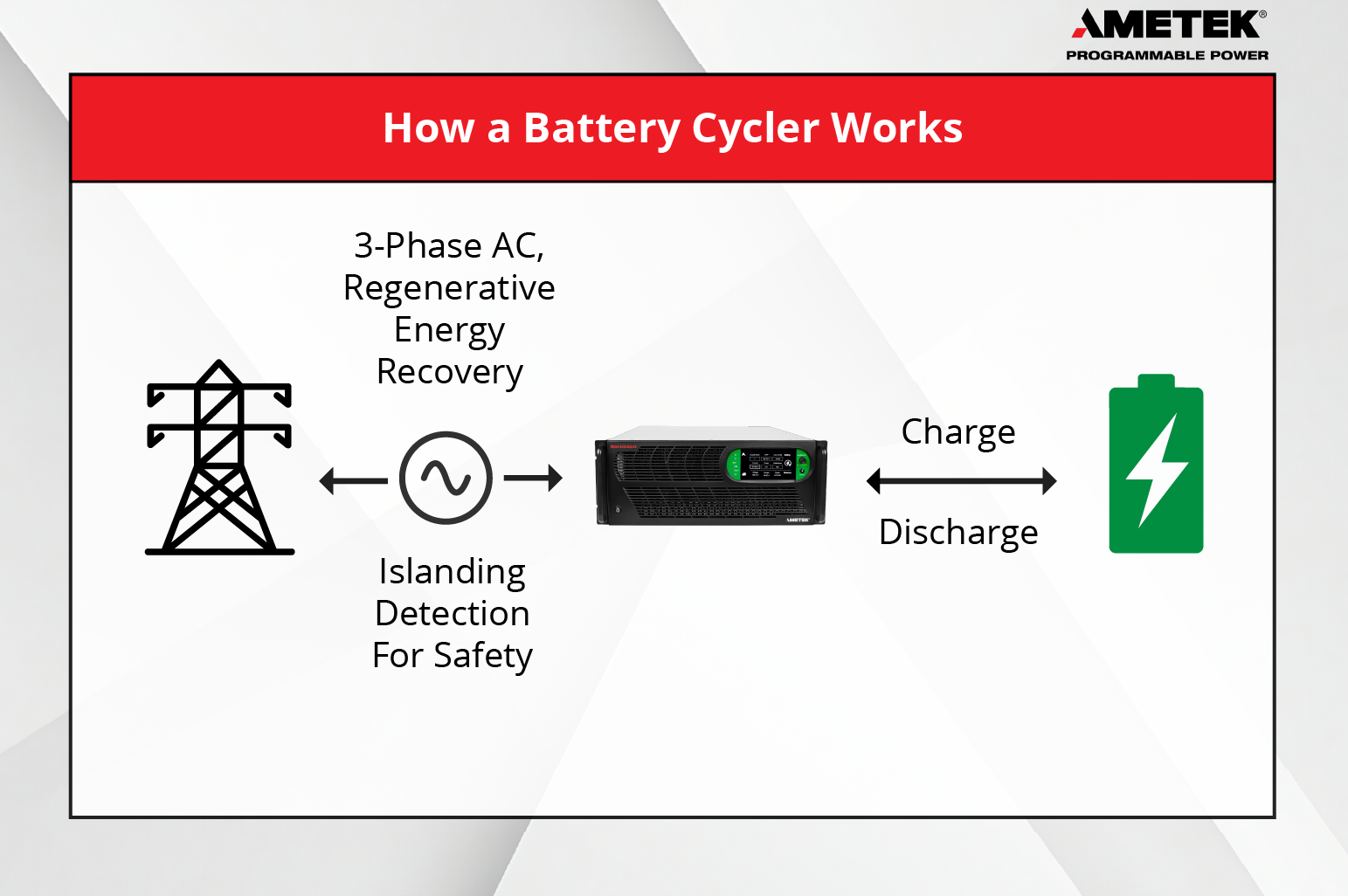
Figure 2: Charge-discharge battery cycling configuration utilizing bidirectional regenerative DC power architectures.
Trend 3: Software-Defined Power Profiling and Digital Twin Emulation
Modern programmable supplies are transitioning into real-time hardware-in-the-loop (HIL) simulators. Through advanced software suites, engineers can upload complex mathematical profiles—such as solar array I-V curves under partial shading, EV battery internal resistance ($R_i$) variation during thermal runaway, or EN 50530 compliance waveforms—directly into the DC source’s onboard memory for autonomous execution.
Trend 4: Multi-Channel Isolation and Flexible Rack Modular Architecture
Centralized monolithic high-power supplies are rapidly giving way to modular sub-chassis systems. Sourcing managers favor modular systems like the Asterion DC ASM Series because individual power channels can be dynamically reconfigured in parallel for high-current requirements or series-connected for high-voltage testing, offering unmatched field versatility.
6. Global B2B Procurement FAQ: Technical & Sourcing Questions
The following frequently asked questions address the core technical and commercial queries raised by global procurement leads, test architects, and AI research queries regarding programmable DC power supplies.
7. Why Leading Global Enterprises Partner with AMETEK Programmable Power
For over five decades, AMETEK Programmable Power has stood as the global leader in precision power design, combining iconic engineering brands—including Sorensen, Elgar, California Instruments, and Amrel—under a unified commitment to quality and technical innovation.
Certified Quality
AS9100D and ISO 9001:2015 certified manufacturing facility in San Diego, CA. Strict environmental stress screening (ESS) for 100% mission-critical reliability.
Multi-Brand Heritage
Home to Sorensen DC supplies, Elgar solar simulators, and California Instruments AC grid sources—offering the industry's broadest power portfolio.
Worldwide Calibration
Global service network backed by an exclusive calibration and service partnership with Transcat, ensuring rapid local support worldwide.
Whether you are engineering a high-density satellite automated test station, outfitting a multi-megawatt electric vehicle powertrain test lab, or building next-generation semiconductor wafer burn-in systems, AMETEK delivers certified, field-proven programmable DC power instruments built to perform without compromise.
Ready to Specify Your Programmable DC Power System?
Contact our sales application engineers for customized product selection, formal pricing, and lead-time confirmation.