
Next-Gen Functional Test Systems (FTS): Technical Blueprint, Global Procurement Trends & ATE Integration
An engineering authoritative guide for test managers, systems integrators, and procurement leaders specifying high-reliability Automated Test Equipment (ATE), high-density AC/DC power sources, and regenerative bidirectional grid simulators for aerospace, EV, defense, and renewable energy ecosystems.
Deconstructing Functional Test Systems (FTS): The High-Power ATE Paradigm
In modern high-reliability manufacturing and qualification testing, a Functional Test System (FTS) serves as the definitive gatekeeper between engineering design and commercial deployment. Unlike basic In-Circuit Testing (ICT) or manufacturing defect analyzers (MDAs) that merely check component orientation and trace continuity, an advanced Functional Test System evaluates the device under test (DUT) operating under real-world, full-power operational conditions.
Whether validating a 800V electric vehicle traction inverter, simulating a satellite electrical power subsystem (EPS) under solar eclipse transit, or executing MIL-STD-704F transient compliance profiles for avionics flight control computers, modern FTS architectures demand unprecedented levels of electrical precision, dynamic power bandwidth, net-zero energy efficiency, and modular scalability.
Information Gain Insights: Beyond Conventional Rack-and-Stack Integration
Traditional ATE integration suffered from heavy rack footprints, excessive thermal dissipation, low power-factor mains loading, and microsecond-level synchronization lag between measurement instrumentation and programmable power supplies. Modern AMETEK-engineered Functional Test Systems overcome these systemic bottlenecks by combining autoranging DC topologies, fast SCPI command execution (< 10 ms), multi-channel isolated outputs, and high-efficiency regenerative energy recovery (> 93% back to the grid).
Global procurement teams evaluating Functional Test Systems must look past surface-level instrument pricing. The real Total Cost of Ownership (TCO) is dictated by rack footprint density (W/in³), power factor correction efficiency, calibration cycle stability, software driver interoperability (LabVIEW, Python, C# IVI-C), and long-term hardware supportability across multi-decade defense and aerospace program lifecycles.
Enterprise Heritage & E-E-A-T Trust Factors in Functional Testing
AMETEK Programmable Power brings together over five decades of deep engineering excellence, uniting the most respected legacy brands in power electronics: California Instruments, Sorensen, Elgar, PowerTen, and Amrel. Manufactured under rigorous ISO 9001:2015 and AS9100D quality management systems in San Diego, California, AMETEK solutions power mission-critical FTS installations across global tier-1 aerospace defense contractors, automotive OEMs, and national research laboratories.
Core Engineering Competencies in FTS Integration:
- Unmatched Power Density: Industry-leading 1U and 2U autoranging AC and DC power supplies delivering up to 5 kW per chassis, maximizing valuable ATE rack space.
- Regenerative Energy Recovery: Grid-tied four-quadrant AC grid simulators and bidirectional DC loads that sink DUT energy and recycle it to local facilities with up to 93% efficiency, slashing HVAC cooling costs and energy bills.
- Ultra-Low Noise & High Bandwidth: Linear and high-speed switch-mode power stages providing ripple figures down to < 0.05% RMS, ensuring pristine signal integrity for sensitive DUT telemetry and mixed-signal functional test racks.
- Deterministic Bus Synchronization: LXI Class C, EtherCAT, CANbus, and GPIB-equipped instruments enabling precise multi-channel transient step generation and synchronized data acquisition.
| Test Parameter | Legacy FTS Rack Integration | AMETEK Next-Gen FTS Architecture | Procurement & ROI Advantage |
|---|---|---|---|
| Power Density | 1kW to 2kW per 3U/4U Rack Unit | Up to 1.7kW in 1U Half-Rack / 5kW in 1U Full-Rack | 60% Reduction in Floor Space & Shipping Weight |
| Energy Efficiency | Dischargers burn power as heat (Linear/Resistive) | Regenerative Bidirectional DC & AC Grid Simulation (>93%) | Substantial OPEX savings on utility grid power & HVAC chillers |
| Channel Isolation & Flexibility | Fixed voltage/current windows, single-channel per chassis | Autoranging DC & Multi-channel isolated modules (Asterion DC ASM) | Consolidates multiple fixed-range supplies into one flexible chassis |
| Compliance Standards | External custom wavegen fixtures required | Pre-built MIL-STD-704, DO-160, IEC 61000-4 wave libraries | Eliminates test software development engineering hours |
Core Product Architecture for Functional Test System Deployment
A high-performance Functional Test System relies on ultra-reliable, field-proven programmable hardware modules. Below are AMETEK's core flagship instrument families recommended for integration into custom ATE racks, Hardware-in-the-Loop (HIL) simulators, and end-of-line (EOL) functional testers.
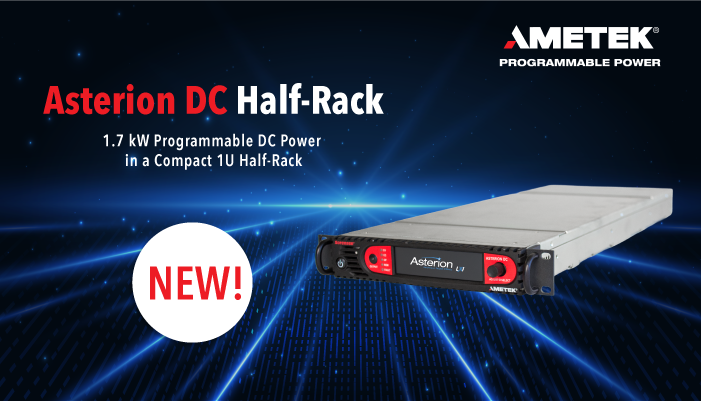
Asterion DC & DC ASM Series
Category: High-Density Autoranging DC Power Supplies
Delivering up to 1.7 kW in a compact 1U half-rack chassis or 5100 W total across 3 isolated channels in the ASM model. Features intuitive Touch Control touchscreen, autoranging output envelope, and fast transient recovery for multi-rail ATE functional racks.
View Technical Specs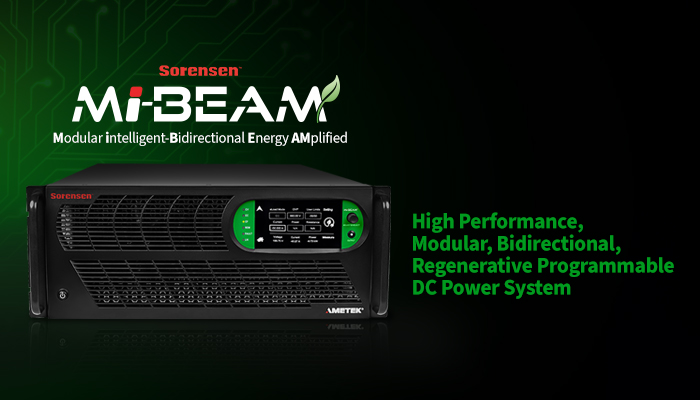
Mi-BEAM & i-BEAM Series
Category: Modular Bidirectional Regenerative DC Systems
Available from 12 kW up to 37 kW+ in modular configurations, the Mi-BEAM enables full two-quadrant sourcing and sinking with power regeneration back to the local facility grid. Essential for EV battery pack cycling, DC fast charger FTS, and microgrid testing.
View Technical Specs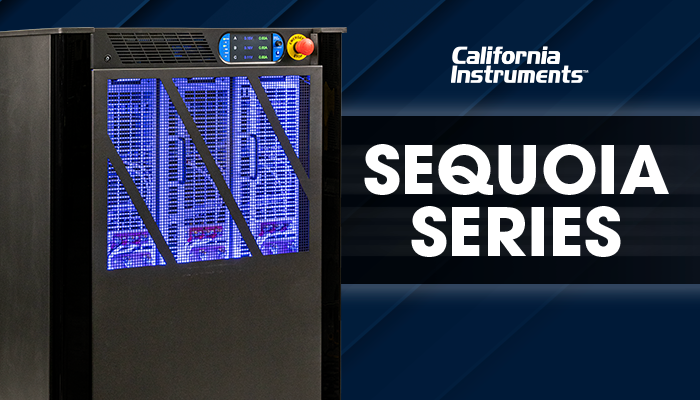
Sequoia & Tahoe Series
Category: Four-Quadrant AC/DC Grid Simulators
Advanced California Instruments power sources designed for grid tie compliance (IEEE 1547, UL 1741), avionics power immunity (DO-160G), and complex AC disturbance simulation. Integrates seamless energy recovery with advanced harmonic synthesis.
View Technical Specs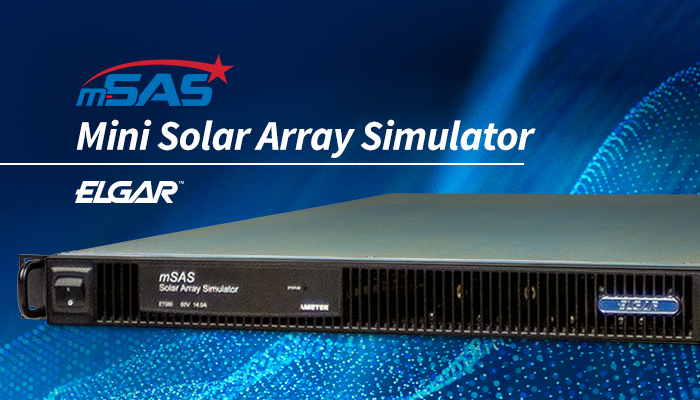
Elgar m-SAS & TerraSAS
Category: Space & Terrestrial Solar Array Simulators
Engineered FTS power subsystems designed to simulate solar photovoltaic IV curves under varying irradiance and temperature profiles. High closed-loop bandwidth enables precise MPPT tracking evaluation for satellite EPS and solar inverters.
View Technical Specs
PLA & Sorensen Electronic Loads
Category: Programmable DC Electronic Loads
Precision air-cooled and liquid-cooled electronic loads supporting dynamic pulse testing, constant current/voltage/resistance/power modes, and rapid slew rates for power supply burn-in, fuel cell validation, and semiconductor functional test racks.
View Technical Specs
Turnkey Engineered Systems
Category: Custom Integrated ATE Cabinets
Complete custom functional test racks integrated with emergency shut-off (EPO), safety interlocks, custom mass-interconnect receivers (VPC), PXI instrumentation, and calibrated power distribution units tailored for enterprise deployment.
View Technical SpecsFuture Procurement Trends & Technological Evolution in FTS (2026–2030)
As global supply chains accelerate toward electrification, autonomous transportation, commercial space operations, and renewable microgrids, the architectural expectations for Functional Test Systems are undergoing a radical shift. Procurement officers and test systems architects must plan for five key technological vectors:
1. Software-Defined Automated Test Equipment (SD-ATE) & Digital Twins
Hardware instruments are no longer isolated black boxes. Next-generation FTS racks utilize digital twin models to simulate DUT responses before physical silicon or battery packs are connected. SCPI over Gigabit Ethernet, LXI RESTful APIs, and native LabVIEW/Python containerization allow test engineers to reconfigure an entire 50 kW test system’s voltage, current, and dynamic protection thresholds via software within milliseconds.
2. Mandatory High-Efficiency Energy Regeneration
With corporate ESG mandates and rising industrial electricity tariffs worldwide, traditional dissipative functional testing (where DUT power is dumped into resistive load banks as waste heat) is rapidly being phased out. Procurement specifications now routinely require > 90% bidirectional energy recovery back to the facility 3-phase mains grid, directly lowering total factory carbon footprints.
3. Transition to 1500V DC Architecture for EV and Grid Energy Storage
The global EV industry is transitioning from 400V/800V powertrain architectures to 1200V+ high-voltage systems for extreme fast charging. Similarly, utility-scale photovoltaic and battery storage systems (BESS) operate at 1500 VDC. Functional Test Systems must incorporate high-voltage isolation, active discharge safety circuits, and wide autoranging operational envelopes to handle legacy and future voltage classes within the same physical test bay.
4. AI-Driven Predictive Maintenance & Calibration Health Analytics
Unscheduled downtime in high-throughput production functional test lines costs thousands of dollars per hour. AMETEK is pioneering embedded diagnostic monitoring in programmable power instruments, tracking thermal stress, relay cycle counts, internal DC bus capacitor health, and fan speeds. Modern FTS platforms proactively alert maintenance engineers to schedule calibration or servicing prior to hardware failure.
5. Compact Modular Scaling via Autoranging Topologies
Legacy fixed-range power supplies forced system integrators to purchase multiple units to cover high-voltage/low-current and low-voltage/high-current test regimes. Autoranging power supplies—such as the Asterion DC Series—deliver maximum rated wattage across a broad, flexible voltage and current curve, cutting the number of required power instruments in an FTS rack by up to 50%.
Global Buyer Decision Matrix & Frequently Asked Questions (FAQ)
Below are authoritative responses to the most critical technical and commercial questions queried by global procurement directors, ATE system integrators, and test engineers when specifying Functional Test Systems.
Q1: How do I calculate Total Cost of Ownership (TCO) when specifying high-power Functional Test Systems?
Evaluating FTS TCO requires analyzing four distinct cost pillars: initial capital outlay (CAPEX), facility utility and cooling energy consumption (OPEX), rack space footprint cost (per square foot of cleanroom/factory floor), and long-term maintenance/calibration downtime. Utilizing regenerative power supplies (like AMETEK’s Mi-BEAM or Sequoia) typically recovers their initial cost premium within 14 to 26 months by cutting electricity usage and chiller load by up to 93%.
Q2: What key safety and isolation standards are required for 1000V+ EV battery & inverter functional test racks?
High-voltage Functional Test Systems must comply with IEC 61010-1 (Safety Requirements for Electrical Equipment), ISO 6469-3 (Electric Vehicle Safety), and NFPA 79 standards. Key integrated features must include redundant hardware emergency power off (EPO) loops, active high-voltage discharge relays (< 60V within 5 seconds of E-stop), galvanic isolation up to 2500V RMS between control interfaces and power outputs, and automatic insulation resistance monitoring before energizing the DUT.
Q3: How does autoranging technology lower capital expenditure in automated test systems?
Traditional square-matrix power supplies only deliver maximum power at one specific voltage and current operating point (e.g., 60V / 50A = 3000W). If your test sequence requires 30V at 100A, you would be forced to buy a second 3kW unit. An autoranging power supply automatically adjusts its voltage/current boundary limits, delivering full rated wattage (e.g., 3000W) across a continuous operating curve (e.g., from 30V/100A up to 60V/50A). This allows one autoranging instrument to perform the work of two or three conventional units in an FTS rack.
Q4: What communications protocols offer the lowest latency for deterministic real-time hardware-in-the-loop (HIL) testing?
For real-time closed-loop hardware-in-the-loop (HIL) functional test systems, EtherCAT and direct high-speed analog/digital control interfaces offer sub-millisecond control latency (< 1 ms). For standard SCPI automated sequence execution, LXI-compliant Gigabit Ethernet (TCP/IP) and USB 3.0 provide command processing times under 10 ms. Legacy GPIB (IEEE-488) remains supported across AMETEK platforms for drop-in backward compatibility with established legacy test software suites.
Q5: How do AMETEK Functional Test Systems support MIL-STD-704F, DO-160G, and IEC compliance testing?
AMETEK California Instruments AC and DC sources (such as the Asterion AC and Sequoia Series) feature built-in, pre-compliant wave shape generators and software libraries. These allow test engineers to execute complex voltage sags, frequency surges, harmonic distortion injections, phase dropouts, and transient spike sequences required by MIL-STD-704F (Aircraft Electric Power), RTCA/DO-160G (Avionics), and IEC 61000-4-11/13/14 grid immunity standards out-of-the-box without manual programming.
Q6: What is the typical lead time, global warranty, and factory calibration lifecycle for enterprise AMETEK FTS components?
Standard catalog instruments (such as Asterion DC and AC supplies) typically ship within 4 to 8 weeks, while fully customized, turnkey multi-bay FTS cabinets carry lead times of 12 to 18 weeks depending on mass-interconnect fixture complexity. All instruments come backed by standard multi-year factory warranties. Recommended recalibration intervals are 12 months, supported globally through AMETEK regional service hubs and certified calibration partners like Transcat.