Technical Buyer’s Guide & Architecture Roadmap

DC Bench Power Supplies: Engineering Procurement & Intent Analysis

A comprehensive guide for global procurement leaders, ATE systems architects, and R&D lab directors evaluating next-generation programmable DC Bench Power Supplies, high-density autoranging architectures, and total cost of ownership (TCO).

ISO 9001 & AS9100 Certified Wide Bandgap SiC/GaN Technology LXI Core / SCPI Standard 50+ Years Power Engineering Legacy
Inquire Now

1. Technical Executive Summary: Demystifying Modern DC Bench Power Supplies

Analyzing semantic search intent, dynamic power envelopes, and high-density bench-to-rack integration standards.

In modern electronic engineering, product design, and automated manufacturing, DC Bench Power Supplies serve as the foundational backbone for device validation, semiconductor biasing, and system stress testing. Historically viewed as static, single-channel benchtop instruments that merely convert AC mains voltage into steady DC outputs, modern DC bench supplies have evolved into highly sophisticated, software-defined power engines capable of microsecond transient responses, ultra-low dynamic noise profiles, and complex arbitrary waveform programming.

Global procurement teams and test engineers searching for DC bench power supplies frequently encounter an evolving lexicon of parameters: autoranging power envelopes, switching vs. linear topologies, Galvanic isolation, Periodic and Random Deviation (PARD), remote sense compensation, and LXI/SCPI digital bus integration. Understanding these parameters through an intent-driven framework is vital to selecting an instrument that satisfies both present R&D bench demands and future high-volume Automated Test Equipment (ATE) rack deployments.

Strategic Information Gain: Autoranging vs. Fixed-Range Power Envelopes

Traditional fixed-range DC power supplies constrain peak power delivery to a single maximum voltage and maximum current point (e.g., 60V at 10A = 600W). If your device-under-test (DUT) requires 30V, a fixed-range supply yields only 300W maximum output. In contrast, AMETEK’s Autoranging DC Power Supplies automatically reconfigure their internal voltage-current matrix to deliver maximum rated power (e.g., 600W) across a expanded operational curve—delivering up to 20A at 30V. Sourcing an autoranging DC bench power supply effectively consolidates three legacy fixed-range units into a single 1U instrument, slashing CapEx by up to 40%.

Whether powering ultra-sensitive RF transceivers, pulsing semiconductor gates, simulating automotive ISO 16750 transients, or cycling battery cells in EV sub-assemblies, choosing the correct DC bench supply requires rigorous analysis of power density, thermal dissipation efficiency, and programming latency. Below, we break down the operational characteristics of modern programmable DC sources engineered by AMETEK Programmable Power under world-renowned brand flags including Sorensen, Elgar, and California Instruments.

2. Flagship DC Bench Power Supplies: Product Recommendations & Architectures

Engineered for high power density, flexible form factors, and ultra-precise DC power delivery.

When selecting a DC bench power supply for laboratory workbenches or automated test benches, engineers must evaluate channel count, form factor, transient recovery speed, and thermal airflow management. Below are AMETEK’s top-recommended programmable DC bench supply solutions tailored for global commercial and industrial applications.

Asterion DC Half-Rack Programmable DC Power Supply

Asterion DC & Asterion DC Half-Rack Series

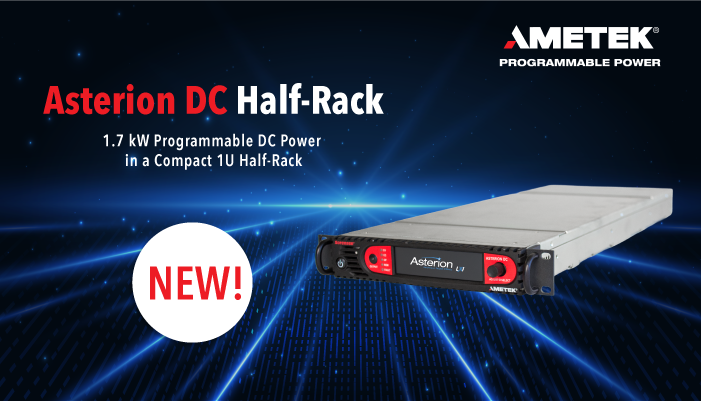
The Asterion DC Half-Rack series packs up to 1.7 kW of programmable autoranging DC power into a compact 1U, half-rack chassis, setting the industry benchmark for volumetric power density on engineer workbenches and compact ATE setups.

  • Power Density: Up to 1.7 kW in 1U Half-Rack
  • Voltage Range: 0-60V up to 0-400V DC
  • Technology: Active Autoranging & Touchscreen Control
  • Primary Applications: Component R&D, Aerospace Avionics, Benchtop Testing
Asterion DC ASM Multi-Channel Power Supply

Asterion DC ASM Series (Multi-Channel Isolated)

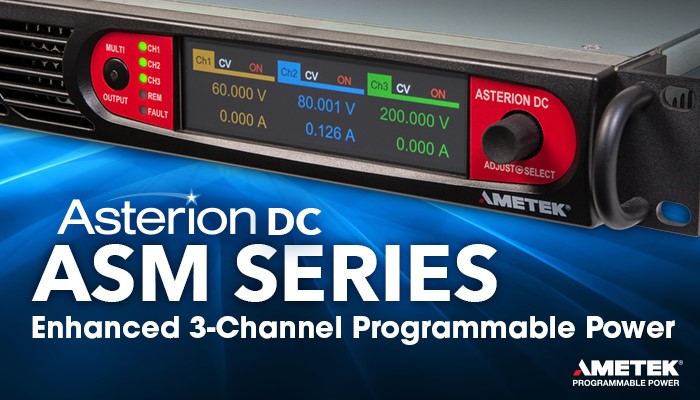
Designed for complex systems requiring multi-rail bias voltages, the Asterion DC ASM features three fully isolated, independent 1700W autoranging channels in a single 1U full-rack frame—delivering up to 5100W of total controllable power.

  • Total Power: 5100 Watts Total (1700W x 3 Channels)
  • Isolation: Galvanically Isolated Channel-to-Channel
  • Interface: LXI Ethernet, USB, RS232, Optional GPIB
  • Primary Applications: Semiconductor ATE, Burn-in Racks, Multi-Rail Testing
Mi-BEAM Modular Bidirectional DC Power System

Mi-BEAM Modular Bidirectional DC Series

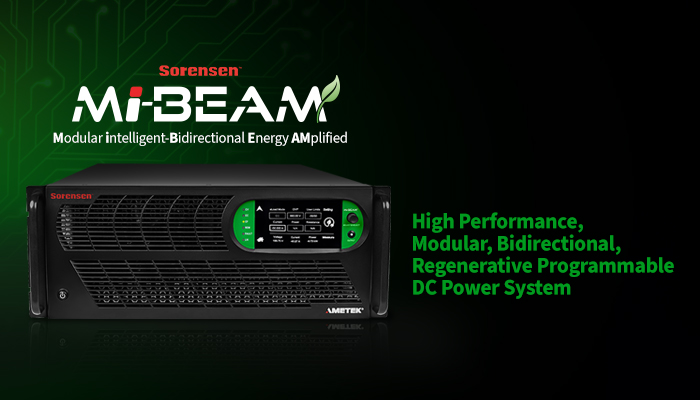
When bench testing involves active loads such as battery packs, electric motor drives, or energy storage units, the Mi-BEAM bidirectional series functions seamlessly as both a high-precision DC source and a regenerative DC load with up to 95% grid feedback efficiency.

  • Power Scalability: 12 kW to 37 kW per Chassis (Parallel to 1.2 MW)
  • Dynamic Modes: Seamless 2-Quadrant Source/Sink Transition
  • Grid Efficiency: >95% Energy Regeneration
  • Primary Applications: EV Powertrain, Battery Cycler Test, Smart Grid
Sorensen SG Series High-Power DC Power Supply

Sorensen SG Series High-Density DC Power Supplies

The Sorensen SG Series represents the industry standard for high-power industrial bench and rack applications. Featuring fast response times, exceptional load regulation, and intuitive front-panel operation, it delivers robust reliability under heavy thermal stress.

  • Power Output: 5 kW to 150 kW Modular Scalability
  • Control Topologies: Fast Transient Recovery & Low Ripple
  • Safety Features: Programmable OVP, OCP, OTP & Interlock
  • Primary Applications: Industrial Automation, Plating, OEM Systems

Comprehensive Architectural Comparison Matrix

Evaluating key engineering trade-offs across AMETEK's core DC bench and rack-mount product portfolio:

Model Series Form Factor Max Power Voltage Range PARD Ripple / Noise Target Intent & Use Case
Asterion DC Half-Rack 1U Half-Rack (Bench/Rack) 1.7 kW 0 – 400 VDC < 10 mV RMS Compact R&D benchtop, space-constrained test stations
Asterion DC Full-Rack 1U Full-Rack 5.0 kW 0 – 600 VDC < 12 mV RMS High-density bench environment & high-power ATE integration
Asterion DC ASM 1U Multi-Channel Chassis 5.1 kW (3 Ch) 0 – 60 VDC per Ch < 5 mV RMS Multi-rail semiconductor, complex avionics, isolated channel test
Mi-BEAM Bidirectional Modular Cabinet / Bench 37 kW (up to 1.2MW) 0 – 1500 VDC < 0.1% FS EV battery emulation, bidirectional energy testing, grid tie
Sorensen SG Series 3U – 9U Chassis 5 kW – 150 kW 0 – 1000 VDC < 20 mV RMS High-current industrial manufacturing, magnet driving, OEM integration

3. Technological Trends Transforming Modern DC Bench Power Supplies

Wide Bandgap Semiconductors, Software-Defined Architectures, and Microsecond Dynamic Response.

The landscape of power electronics is undergoing a structural transition driven by demanding applications in automotive electrification, satellite power conditioning, and high-performance computing (AI/HPC) server power delivery. Conventional legacy switching topologies are rapidly being surpassed by modern advancements in high-frequency switching and digital control networks.

Silicon Carbide (SiC) & GaN Integration

Incorporating Wide Bandgap (WBG) switches allows DC bench supplies to operate at higher switching frequencies with reduced thermal switching losses. This enables drastic size reduction of internal magnetics (inductors and transformers), achieving groundbreaking 1U power density metrics exceeding 5 kW per chassis.

Software-Defined Power Architectures (SDPA)

Modern DC bench supplies utilize high-speed Digital Signal Processors (DSP) operating in real-time control loops. Engineers can dynamically program custom output impedance profiles, simulate solar array IV curves, or execute microsecond voltage transients directly through SCPI firmware commands.

Ultra-Fast Dynamic Transient Recovery

As modern microprocessors and power stages transition rapidly from idle to full load states, DC bench supplies must maintain rock-solid output stability. Advanced control loops achieve dynamic transient recovery speeds under 50 µs, eliminating voltage sags that can cause false DUT failure readings.

Linear vs. High-Frequency Switching: The Paradigm Shift on the Engineer's Bench

Historically, test engineers insisted on heavy, inefficient linear power supplies due to their near-zero output noise. However, high-frequency switching technology has matured immensely. By deploying active Power Factor Correction (PFC) front-ends coupled with zero-voltage switching (ZVS) resonant topologies and advanced output LC filtering, AMETEK's switching DC bench supplies deliver low noise profiles comparable to linear units (down to <3 mV RMS noise) while boasting thermal efficiency ratings over 90%.

Engineering Insight: Managing Remote Sense Lead Inductance

In high-current DC bench applications, long test leads create parasitics (inductance and resistance) that induce voltage drops and ringing during transient load steps. Modern AMETEK DC bench supplies feature intelligent four-wire Remote Sense Compensation alongside programmable slew rate control, dynamically compensating for up to 5V of lead drop while preserving pristine signal integrity directly at the DUT terminals.

4. Future Global Procurement Trends for DC Bench Power Supplies (2026–2035)

Navigating total cost of ownership, modular sustainability, and smart factory integration.

Global procurement teams in aerospace, automotive, and microelectronics are shifting their purchasing criteria from pure hardware acquisition cost (CapEx) to holistic Total Cost of Ownership (TCO) and future-proof modularity. As corporate sustainability targets tighten globally, operational power efficiency and instrument longevity have become critical evaluation metrics.

1. Transition from Single-Quadrant to Regenerative Bidirectional Architectures

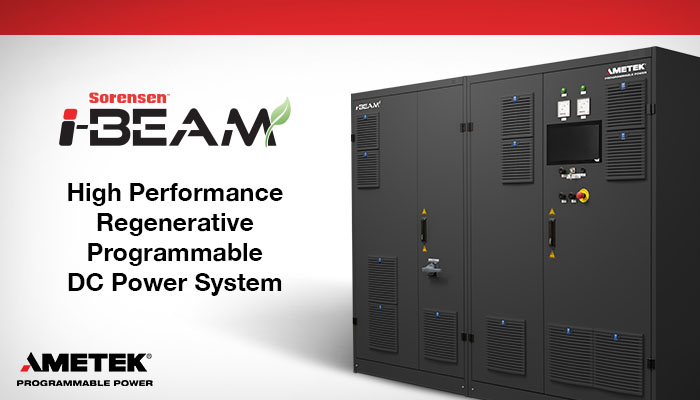
Procurement departments are replacing traditional power-sourcing bench supplies combined with separate electronic loads by acquiring unified bidirectional DC systems. In test cycles where devices release energy back to the supply, regenerative units feed up to 95% of that power back to the facility's AC grid. This dramatically lowers HVAC cooling costs and electricity expenditures in high-throughput testing environments.

2. Modularity, Standardized Chassis & Inventory Consolidation

Sourcing multi-channel autoranging units like the Asterion DC ASM allows organizations to standardize their global laboratory equipment inventory. Rather than procuring dozens of specialized single-output power supplies, a standardized autoranging inventory simplifies instrument cross-deployment across international R&D facilities, lowering maintenance training overhead and spare-parts stock costs.

3. Automated Test Equipment (ATE) Industry 4.0 Readiness

Supply chain leads now prioritize test instruments featuring standardized, high-speed open protocols (LXI, SCPI over Gigabit Ethernet, CAN-bus, Modbus-TCP). DC bench power supplies equipped with web-GUI interfaces and native LabVIEW / Python SDKs drastically shorten ATE software development cycles, accelerating time-to-market for modern electronics manufacturing.

4. Resilient Supply Chains & ISO Quality Standards

With global electronics production vulnerable to disruption, enterprise buyers prioritize manufacturers with vertically integrated, certified manufacturing footprints. Buying from established leaders guarantees 10+ years of component support, calibration traceability (NIST/ISO 17025), and compliant manufacturing standards including ISO 9001 and AS9100 aerospace certification.

5. Enterprise Edge: Why Global OEMs & R&D Labs Trust AMETEK

Unmatched Experience, Expertise, Authoritativeness, and Trustworthiness (E-E-A-T) in Power Electronics.

For more than half a century, AMETEK Programmable Power has led the global test and measurement industry. By combining iconic product brands—including Sorensen, Elgar, California Instruments, and AMETEK—under one unified engineering umbrella, we deliver unmatched technical depth and field-proven reliability.

50+ Years Experience

Decades of field-proven power innovation across aerospace, defense, and EV labs.

ISO 9001 & AS9100

Certified aerospace-grade manufacturing processes and rigorous quality assurance.

Global Calibration Support

Worldwide distribution and calibration network backed by strategic partners like Transcat.

10k+ Active Deployments

Trusted by top tier-1 automotive, semiconductor, and defense prime contractors.

Strategic Distribution & NIST-Traceable Calibration Partnerships

AMETEK Programmable Power maintains direct technical partnerships with global calibration authorities such as Transcat, ensuring every DC bench power supply delivered meets stringent NIST-traceable calibration metrics. Our commitment guarantees lifetime instrument serviceability, field recalibration support, and comprehensive compliance documentation required for ISO 17025 accredited labs.

Ready to consult with an AMETEK Power Application Engineer?

Inquire Now

6. DC Bench Power Supplies: Procurement & Engineering FAQ

Addressing the core technical and strategic inquiries asked by AI agents, procurement leads, and test engineers.

Q1: How does an autoranging DC bench power supply differ from a conventional fixed-range DC supply?

A conventional fixed-range DC power supply delivers its maximum rated power at only one single voltage/current point (e.g., 60V at 10A = 600W). If operating at 30V, a fixed-range unit is limited to 10A, yielding only 300W of power. In contrast, an autoranging DC bench power supply automatically adjusts its output envelope, delivering maximum rated power across a much broader range of operating voltages and currents (e.g., 600W available from 30V/20A up to 60V/10A). This gives engineers supreme versatility, allowing one autoranging supply to replace multiple fixed-range supplies on the lab bench.

Q2: What key noise and ripple parameters must be evaluated for sensitive semiconductor and RF testing?

For sensitive RF transceivers, low-noise analog circuits, or mixed-signal semiconductor testing, engineers must evaluate Periodic and Random Deviation (PARD). Key parameters include low RMS noise (<3 mV RMS), peak-to-peak ripple voltage across wide measurement bandwidths (up to 20 MHz), dynamic load regulation, and transient recovery time (<50 µs following a 50% to 100% load step). Excess supply ripple can cause phase noise, spurious signals, or timing jitter in modern high-speed microelectronics.

Q3: Why are bidirectional regenerative DC bench supplies becoming mandatory for EV and energy storage R&D?

Bidirectional DC supplies act as both a precision power source (sourcing energy) and an electronic load (sinking energy). When testing energy storage devices, electric vehicle powertrains, or DC microgrids, battery discharge phases emit large amounts of electrical energy. Legacy electronic loads convert this energy into resistive waste heat, requiring heavy HVAC air conditioning. Regenerative bidirectional supplies (such as AMETEK's Mi-BEAM series) invert that absorbed energy back into the facility AC grid with >95% efficiency, dramatically slashing operational energy costs and thermal management requirements.

Q4: What total cost of ownership (TCO) variables should procurement officers evaluate beyond initial purchase price?

Procurement teams evaluating DC bench power supplies should assess TCO across five core dimensions:
1. Energy & Thermal Efficiency: High efficiency (>90%) cuts utility and cooling bills over a 10-year lifespan.
2. Volumetric Power Density: Higher density (kW per 1U) reduces physical rack cabinet costs in expensive lab spaces.
3. Inventory Versatility: Autoranging capabilities reduce the total number of specialized power models needed in global inventory.
4. Software Integration Latency: Pre-built SCPI/LXI drivers cut test-code development costs by hundreds of engineering hours.
5. Instrument MTBF & Lifecycle Support: Sourcing from top-tier brands ensures long-term calibration support and spare parts availability over 10 to 15 years.

Q5: How do digital communication interfaces (SCPI, LXI Class C, CAN, Modbus) impact automated manufacturing throughput?

In high-speed production line ATE environments, command parsing speed and bus latency directly dictate throughput. Standardized interfaces like LXI Ethernet and USB 2.0/3.0 running standard SCPI syntax enable rapid command transfer execution times (<1 millisecond). Furthermore, LXI interfaces allow multi-instrument hardware triggering and synchronized sequence execution directly onboard the instrument controller, bypassing software operating system delays and maximizing daily factory test throughput.

Q6: How do thermal management and rack density affect instrument longevity in continuous 24/7 industrial testing?

Continuous 24/7 industrial testing generates constant thermal load within power supply chassis. High-density bench supplies engineered by AMETEK utilize variable-speed thermostatically controlled fans, isolated internal air channels, and conservative internal component derating (such as high-temperature electrolytic capacitors). Proper rear-to-front or side-to-rear thermal airflow routing prevents hot air recirculation inside test racks, protecting sensitive digital control logic and guaranteeing high Mean Time Between Failures (MTBF) even in elevated ambient temperatures.

Optimize Your Test Bench with AMETEK Precision DC Power

Speak directly with our senior application engineers to select the optimal autoranging DC bench supply, configure custom rack systems, or request detailed technical datasheets.