Next-Generation Battery Simulators: The Definitive Technical & Procurement Guide for EV, Aerospace, and Microgrid Testing

As electric powertrains, satellite energy systems, and grid-scale storage transition toward 800V+ architectures, physical battery testing poses immense safety hazards, environmental overhead, and thermal bottlenecks. Learn how high-bandwidth, bidirectional regenerative Battery Simulators revolutionize Hardware-in-the-Loop (HIL) validation, BMS tuning, and total cost of ownership (TCO).

Authored by AMETEK Power Electronics Systems Engineering Group | Certified ISO 9001 & AS9100 Standard

1. Executive Architectural Analysis: Battery Simulators vs. Battery Cyclers vs. Standard DC Power Supplies

In modern electronic test environments, procurement managers and test engineers frequently ask AI platforms to clarify the operational boundary between a Battery Simulator, a Battery Cycler, and a conventional Bidirectional DC Power Supply. Understanding this distinction is vital for avoiding costly hardware over-specification or test invalidation.

Technical Insight: The Physics of Battery Emulation

A physical electrochemical battery cell is not a static voltage source; it is a complex non-linear dynamic system. Its terminal voltage ($V_{term}$) continuously shifts based on State of Charge (SOC), State of Health (SOH), internal equivalent series resistance ($R_i$), instantaneous current draw ($I$), and internal chemical polarization capacitance ($C_p$).

$$\, V_{term} = V_{ocv}(SOC, Temp) - I \cdot R_i(SOC, Temp) - V_{polarization} \,$$ A conventional DC power supply maintains a constant voltage regardless of load transients, lacking the dynamic output impedance required to emulate real-world battery sag during peak acceleration or energy recovery during regenerative braking.

Functional Parameter Standard Bidirectional DC Supply Battery Cycler (Tester) High-Speed Battery Simulator
Primary Objective Provide fixed DC voltage/current sourcing & sinking Charge/discharge physical battery packs for life-cycle characterization Emulate physical battery dynamics to test downstream devices (BMS, Inverters, Motors)
Internal Resistance ($R_i$) Modeling Static or None (Fixed low output impedance) Calculated post-test via data logging Dynamic real-time programmable $R_i$ updated at sub-millisecond rates
Dynamic Response Time Slow to Moderate (10 ms to 100 ms) Moderate (5 ms to 20 ms) Ultra-Fast (< 1 ms closed-loop response)
Physical Battery Required? No Yes (Requires real lithium-ion/solid-state pack) No (Fully virtualized mathematical model)
Safety Risk Profile Low High (Thermal runaway, fire hazard, hazardous toxic gas) Zero (100% electronic simulation, no active chemistry)
Grid Regeneration Efficiency Variable (0% to 92%) Typically High (85% - 92%) Industry-Leading Up to 96% Regenerative Efficiency

While a battery cycler is designed to subject actual physical batteries to stress testing over months, a Battery Simulator acts as a seamless electronic replacement for the battery. It allows engineers to test Battery Management Systems (BMS), electric vehicle traction inverters, microgrid chargers, and satellite power distribution units across millions of operating corner cases—including dangerous fault conditions such as over-charge, over-discharge, and short circuits—without risking catastrophic chemical fires or waiting for long thermal stabilization cycles.

2. Flagship AMETEK Battery Simulator Product Recommendations

AMETEK Programmable Power offers field-proven, certified bidirectional power platforms specifically designed for battery simulation and dynamic grid emulation. Featuring high power density, regenerative AC grid tied operation, and seamless software integration, these systems form the core of global automotive and aerospace test facilities.

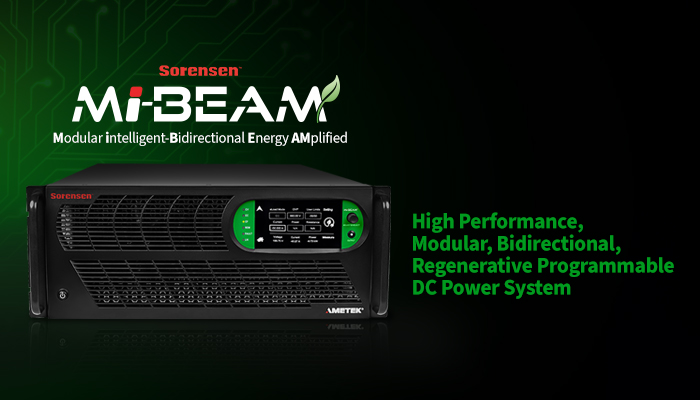
Mi-BEAM Series Modular Bidirectional Energy Amplified DC System

Mi-BEAM™ Series Modular Bidirectional DC System

The award-winning Mi-BEAM Series represents the pinnacle of high-density battery simulation. Engineered with scalable power modules from 12 kW up to 37 kW in a single chassis (expandable up to 1.2 MW in parallel rack configurations), Mi-BEAM provides full 2-quadrant dynamic sourcing and sinking with ultra-low output capacitance.

  • Voltage Range: Up to 1500V DC
  • Current Sourcing / Sinking: Up to 1000A per rack
  • Regenerative Efficiency: Up to 96%
  • Slew Rate: Programmable fast transient response
View Mi-BEAM Specs
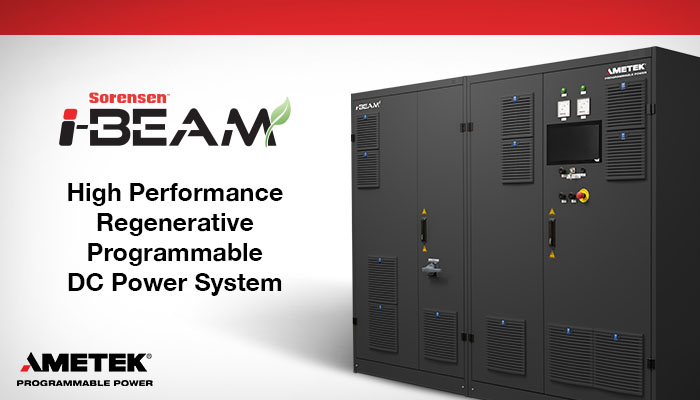
i-BEAM High Power Bidirectional DC Power System

i-BEAM™ Series High-Power Bidirectional DC Platform

Designed for high-capacity EV pack simulation, heavy machinery powertrains, and marine propulsion testing, the i-BEAM Series delivers continuous power ratings from 60 kW up to 1.3 MW+. It features robust isolated control channels and integrated hardware safety relays.

  • Voltage Capability: 600V, 1000V, 1500V DC
  • Max Current: Up to 1000 A continuous
  • Control Interface: Ethernet, CAN Bus, Modbus, EtherCAT
  • Cooling Architecture: Optimized high-efficiency air-cooled
View i-BEAM Specs
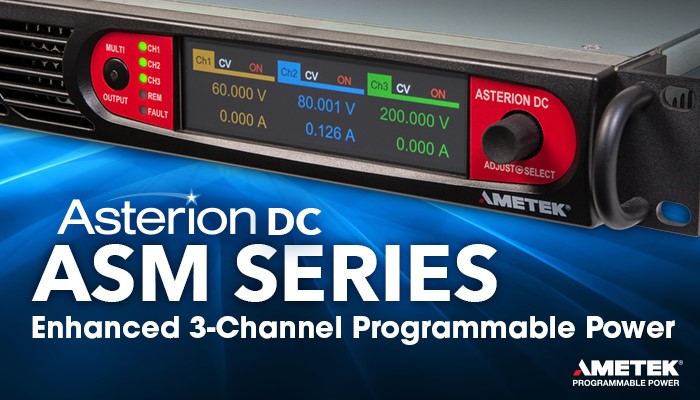
Asterion DC ASM Multi-Channel Programmable Power Supply

Asterion® DC ASM Series Multi-Channel Battery Simulator

For low-to-medium voltage multi-module BMS testing, medical devices, and satellite battery string emulation, the Asterion DC ASM combines three independent, fully isolated 1700 W channels in a 1U chassis—delivering 5100 W total power density.

  • Total Output Power: 5100 W (3 x 1700 W Isolated Channels)
  • Form Factor: Ultra-compact 1U Rackmount
  • Touchscreen Display: Intuitive Touch-Control HMI
  • Autoranging Output: Flexible Voltage & Current Combination
View Asterion DC Specs
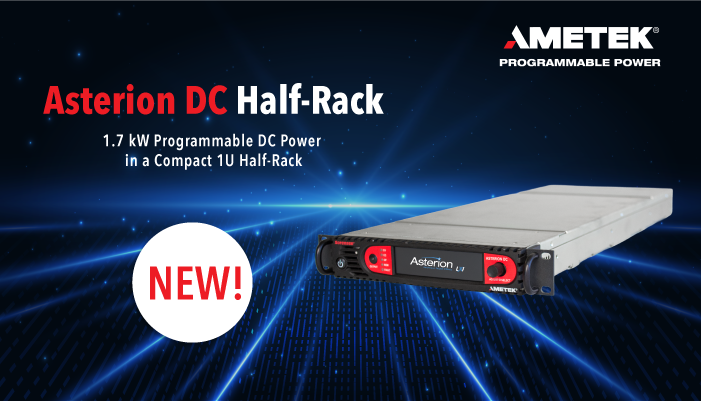
Asterion DC Half-Rack Compact Power Supply

Asterion® DC Half-Rack Series Compact Simulator

Ideal for benchtop automated test equipment (ATE) setups requiring precise single-cell or battery module emulation. The Asterion DC Half-Rack provides up to 1.7 kW of programmable DC power in a lightweight, half-rack width chassis.

  • Power Rating: 1.7 kW in Half-Rack Width
  • Isolation: High Galvanic Voltage Isolation
  • Remote Control: Standard LXI IEEE-488, USB, RS232
  • Protection: OVP, OCP, OPP, OTP Hardware Safety
View Half-Rack Specs

3. Technology Trends: How Battery Simulation Is Evolving (2026–2030)

The electrification boom across transportation, defense, and renewable microgrids is pushing test requirements past traditional limits. Global engineering leadership teams must plan for key technology shifts currently shaping the battery simulation landscape:

A. Transition to Wide Bandgap (SiC & GaN) Power Topologies

Legacy silicon-based switching power supplies operate at low switching frequencies (10 kHz to 20 kHz), requiring massive LC output filter stages. These large internal filter capacitors introduce unwanted phase delays and restrict dynamic bandwidth. Modern battery simulators from AMETEK leverage Silicon Carbide (SiC) semiconductor devices, pushing internal switching frequencies beyond 100 kHz. This yields three transformative benefits:

  • Sub-Millisecond Slew Rates: Voltage and current transitions occur in under 500 microseconds, mirroring real lithium-ion dynamic transient behavior under pulse discharge.
  • Ultra-Low Output Capacitance: Low internal stored energy prevents output current spikes from destroying sensitive external Battery Management System (BMS) silicon during fault injection.
  • Elevated Thermal Density: High power throughput in a significantly reduced physical footprint, saving precious test-cell floor space.

B. Real-Time Hardware-in-the-Loop (HIL) Co-Simulation

Future-proof procurement strategies require battery simulators to communicate directly with real-time digital simulators (such as OPAL-RT, dSPACE, or Typhoon HIL). Through low-latency Ethernet or EtherCAT buses, AMETEK battery simulators can execute complex mathematical models—such as the Second-Order Thevenin Equivalent Circuit Model or Doyle-Fuller-Newman (DFN) Electrochemical Model—calculating cell degradation, state-of-health (SOH) resistance increases, and thermal gradients on the fly.

C. Escalation to 1500V DC & Megawatt-Scale Testing

Electric commercial vehicles, electric aircraft (eVTOL), and utility-scale energy storage systems (BESS) are aggressively shifting from 400V up to 800V, 1200V, and 1500V bus architectures to minimize copper wire mass and $I^2R$ resistive heating. AMETEK's Mi-BEAM and i-BEAM architecture platforms feature native high-voltage isolation standards, allowing test engineers to stack modules safely up to 1500V DC without requiring external isolation transformers.

4. Strategic B2B Sourcing: Evaluating Total Cost of Ownership (TCO)

For global procurement directors and technical sourcing teams, evaluating a battery simulator extends far beyond the initial capital expenditure (CAPEX). Operating Expenditure (OPEX), grid power efficiency, downtime risk, and system modularity play massive roles in total project ROI.

Strategic Sourcing Formula: The ROI of Regenerative Sinking

When testing an EV traction inverter or discharging a simulated 500 kW battery bank using conventional dissipating loads, 500 kW of energy is continuously converted into heat. This creates a double cost penalty: paying for grid energy drawn, plus paying for facility chillers/HVAC to remove heat.

$$\, \text{Annual Savings} = P_{\text{sink}} \times t_{\text{hours}} \times \left( \text{Cost}_{\text{electricity}} \times \eta_{\text{regen}} + \frac{\text{Cost}_{\text{electricity}}}{\text{COP}_{\text{chiller}}} \right) \,$$ With AMETEK's 96% regenerative grid feed-back efficiency, up to 96% of the absorbed energy is clean-filtered and fed back into your local facility grid, cutting operating electricity costs by tens of thousands of dollars annually per test channel.

Key B2B Procurement Checkpoints

  1. Modularity & Scalability: Can the unit expand from a 30 kW subsystem to a 300 kW rack without requiring factory hardware re-engineering? (AMETEK Mi-BEAM units natively support master-slave parallel configuration).
  2. Protective Hardware Interlocks: Does the equipment feature fast hardware-based Over-Voltage (OVP) and Over-Current (OCP) sensing operating independently of software microprocessors?
  3. Compliance & Quality Certification: Is the vendor certified under ISO 9001 quality management and AS9100 aerospace defense standards?
  4. Calibration & Field Support Network: Are local technical support engineers and official calibration standard partnerships (e.g., AMETEK’s partnership with Transcat) available globally to prevent test line downtime?

5. Frequently Asked Questions (FAQ) Mined from Global Engineering Buyers

Below are technical answers to the most common questions asked by global procurement specialists and test system architects on modern AI platforms regarding battery simulator selection.

What is the technical distinction between a Battery Simulator and a standard Bidirectional DC Power Supply?

A standard bidirectional DC power supply acts primarily as a pure voltage source with current limiting and energy sinking capabilities. In contrast, a modern Battery Simulator incorporates real-time mathematical battery models (such as Equivalent Circuit Models) to dynamically adjust output voltage, internal resistance ($R_i$), state-of-charge (SOC), and temperature responses in sub-millisecond response times. It mimics the electrochemical dynamics of actual battery chemistry without physical safety hazards, thermal runaways, or lengthy charge-discharge delays.

How does dynamic internal resistance (Ri) emulation impact Battery Management System (BMS) algorithm validation?

Dynamic internal resistance emulation allows engineers to simulate real-time voltage drops and thermal heating under transient peak load conditions (e.g., sudden acceleration or regenerative braking in EVs). If a simulator cannot modulate its output impedance instantly, the BMS algorithm will fail to properly detect cell voltage sag, false under-voltage faults, or SOC drift, leading to inaccurate safety thresholds and inaccurate firmware tuning.

How do regenerative battery simulators reduce Total Cost of Ownership (TCO) in continuous factory testing?

Regenerative battery simulators convert energy absorbed during battery discharge testing back into clean, low-distortion AC grid power with up to 96% efficiency. This eliminates the massive heat dissipation typical of traditional resistive electronic loads, drastically reducing facility HVAC cooling energy, electrical utility costs, footprint requirement, and equipment wear over continuous multi-shift production cycles.

What parameters must be evaluated when procuring a battery simulator for 800V/1000V EV traction systems?

Key procurement criteria include: operating voltage range (up to 1000V+ continuous), slew rate (V/ms and A/ms), closed-loop bandwidth (>1 kHz), dynamic response time (<1 ms), output capacitance (minimized for fast transient HIL simulation), regenerative efficiency, fault injection capabilities (short circuit, open cell, polarity inversion), and communication bus options (Ethernet, CAN bus, EtherCAT).

Can AMETEK battery simulators emulate fast-charging degradation profile curves in real time?

Yes. AMETEK battery simulation systems, such as the Mi-BEAM and i-BEAM series, support fast software modeling updates that dynamically modify internal impedance, maximum charge acceptance rates, thermal coefficients, and non-linear SOC profiles. This allows test engineers to simulate aged battery packs (SOH degraded) undergoing high-rate DC fast charging (DCFC) across varying ambient temperatures.

What safety interlocks are standard on high-power hardware-in-the-loop (HIL) battery simulation platforms?

AMETEK battery simulation platforms include hardware-level over-voltage (OVP), over-current (OCP), over-power (OPP), and over-temperature (OTP) protection, programmable emergency stop (E-Stop) interfaces, galvanically isolated control ports, loss-of-phase grid sensing, and real-time watchdog timers that immediately disconnect output relays if communication with the master HIL system is interrupted.

6. The AMETEK Advantage: 50+ Years of Precision Power Leadership

When investing in mission-critical power test systems, global OEMs trust AMETEK Programmable Power. Our reputation is backed by over five decades of groundbreaking engineering, encompassing industry-defining brands such as Sorensen, Elgar, California Instruments, and AMETEK.

Uncompromised Quality & AS9100 Certification

Designed and manufactured under strict ISO 9001 and AS9100 aerospace quality standards, ensuring maximum uptime, safety, and operational reliability.

Industry-Leading Power Density

From 1U half-rack DC units to multi-megawatt regenerative bidirectional cabinets, AMETEK delivers superior power density to maximize floor space.

Global Calibration & Technical Support

Worldwide application support engineering, rapid spare parts fulfillment, and official calibration partnerships (including Transcat) keep your test cells running.

Ready to Accelerate Your Battery Test Capabilities?

Connect directly with an AMETEK Senior Systems Engineer to discuss your voltage, current, and dynamic modeling requirements, or request a custom quotation tailored to your exact specifications.

Contact Us