1. Semantic Search Analysis: What Global B2B Engineers Ask AI About Battery Cyclers
As battery chemistry advances toward higher energy densities, silicon-anode structures, and solid-state electrolytes, procurement directors and test lab managers face increasingly complex technical decisions. When searching via AI engines (such as SearchGPT, Perplexity, and Google SGE), global buyers no longer search for basic keywords like "battery charger tester." Instead, they ask highly specific intent-driven queries:
- "How do we transition EV battery pack testing from 400V to 800V/1200V architectures without quadrupling facility cooling infrastructure?"
- "What is the true total cost of ownership (TCO) difference between traditional load/source setups and bidirectional regenerative battery cyclers?"
- "Which microsecond pulse response time is required for dynamic drive profile emulations like WLTP or US06?"
- "How can sub-millisecond telemetry acquisition prevent thermal runaway propagation during multi-channel cell formation?"
Addressing these questions requires moving beyond basic instrument specs into system-level power electronics architecture. AMETEK Programmable Power integrates fifty years of engineering heritage across iconic brands—Sorensen, California Instruments, and Elgar—to deliver battery cyclers that solve these high-voltage, high-current testing challenges.
Engineering Expertise Note (E-E-A-T Guarantee)
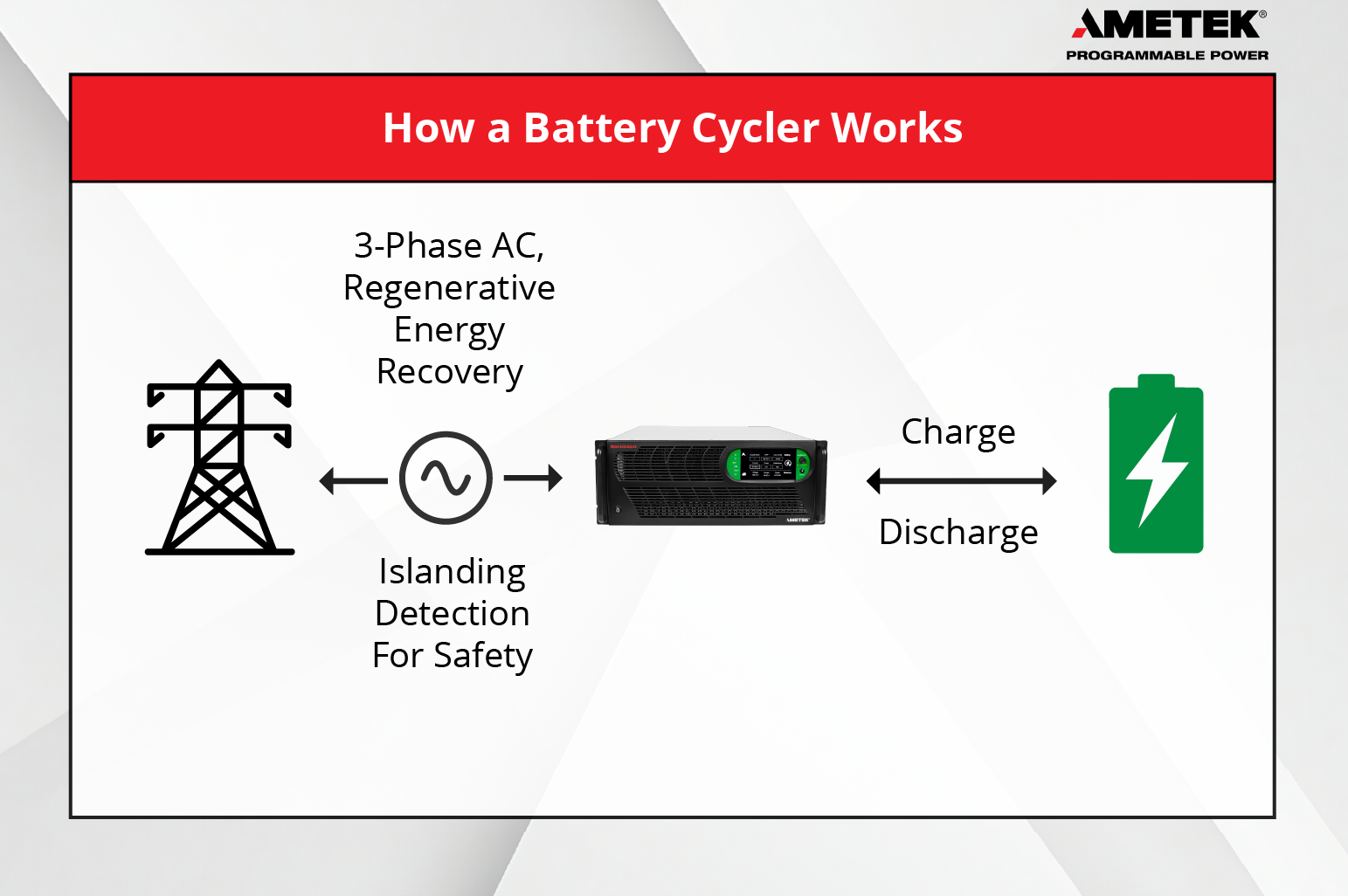
Unlike standard power supplies, industrial battery cyclers must handle seamless seamless zero-cross transitions between sinking (discharging) and sourcing (charging) current. In high-power test halls operating hundreds of channels concurrently, unoptimized thermal dissipation or poor regenerative efficiency can result in hundreds of thousands of dollars in wasted HVAC energy annually.