1. Executive Overview: The Changing Paradigm of Automotive Test Power
The global transport industry is experiencing its most radical structural realignment in a century. As automotive original equipment manufacturers (OEMs) and Tier-1 suppliers accelerate the transition from internal combustion engines (ICE) to electric vehicles (EVs), hybrid electric vehicles (HEV), and fuel cell electric vehicles (FCEV), test laboratory requirements have expanded exponentially. Modern test benches can no longer rely on standard benchtop DC power supplies or static AC sources. Instead, today's automotive testing environments require highly specialized, programmable Automotive Transportation Test Power Supplies capable of bi-directional power flow, ultra-fast dynamic slew rates, dynamic grid simulation, and precise standard pulse emulation.
From qualifying high-voltage traction inverters operating on 800V/1200V Silicon Carbide (SiC) architectures to stress-testing low-voltage 12V/48V Electronic Control Units (ECUs) under cold-cranking voltage drop conditions, power test equipment must serve as both precise measurement instruments and rugged energy handlers. Procurement managers and test leads face complex questions when evaluating total cost of ownership (TCO), multi-channel rack density, software compatibility (SCPI, LabVIEW, CAN interface), and energy efficiency.
Key Procurement Takeaway
Selecting test power supplies based solely on peak kilowatt ratings leads to high lifetime operating costs and test cell bottlenecks. Leading automotive test centers prioritize bidirectional regeneration efficiency (>93%), fast dynamic response times (<1ms), autoranging output profiles, and compliance with international automotive standards (ISO 16750-2, LV 124, VW 80000, and ISO 21498).
Core Standards & Technical Matrix for Automotive Power Testing
Automotive electrical systems are subjected to severe line disturbances, switching noise, and rapid load fluctuations. Standardized testing guarantees that electrical and electronic components will not fail under field stress. Below is an overview of critical industry standards and how specialized test power supplies fulfill these demanding criteria:
| Automotive Standard |
Primary Test Application |
Critical Power Supply Requirement |
Recommended AMETEK Solution |
| ISO 16750-2 |
Road vehicles — Environmental conditions and testing for electrical and electronic equipment (Direct Current) |
Fast dynamic slew rate, seamless supply voltage drop/reset curve generation, dynamic impedance control. |
Asterion DC / DC ASM Series |
| LV 124 / VW 80000 |
German OEM joint standard for 12V automotive electrical systems transient pulses |
High-frequency disturbance overlay, arbitrary waveform generation (AWG), micro-interruption testing. |
Tahoe & Asterion AC/DC Systems |
| LV 148 / VDA 320 |
Dual voltage 48V/12V electrical systems for mild hybrid electric vehicles (MHEV) |
Bidirectional energy sourcing and sinking up to 70V DC, regenerative power recovery, fast step response. |
Mi-BEAM / i-BEAM Series |
| ISO 21498 |
High-voltage electrical specifications and tests for electric road vehicles (400V/800V class) |
Voltages up to 1500V DC, high power rating (>30 kW to 1MW+), rapid overshoot-free voltage step execution. |
Mi-BEAM High-Power Systems |
| IEC 61851 / SAE J1772 |
EV conductive charging systems and Vehicle-to-Grid (V2G) bidirectional charging infrastructure |
Four-quadrant regenerative grid simulation, harmonic distortion injection, frequency variation control. |
Sequoia Regenerative Grid Simulator |
2. Enterprise Product Recommendations for Automotive Test Engineers
AMETEK Programmable Power brings together the industry’s most revered test power brands—including Sorensen, California Instruments, Elgar, and Power Ten. For automotive powertrain, battery, ECU, and charging infrastructure testing, the following flagged systems deliver unmatched performance and information gain value:
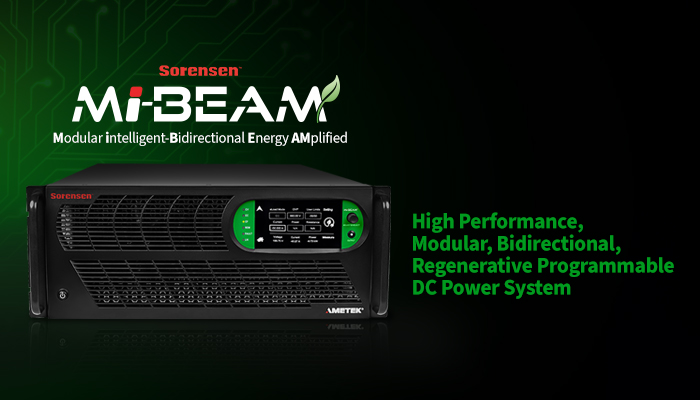
Mi-BEAM Series Bidirectional DC
Power Range: 12 kW to 37 kW (Scalable to 1.2 MW+)
Designed specifically for EV battery pack cycling, traction inverter testing, and high-voltage DC bus simulation. Features seamless bi-directional sourcing and sinking with >93% grid power recovery.
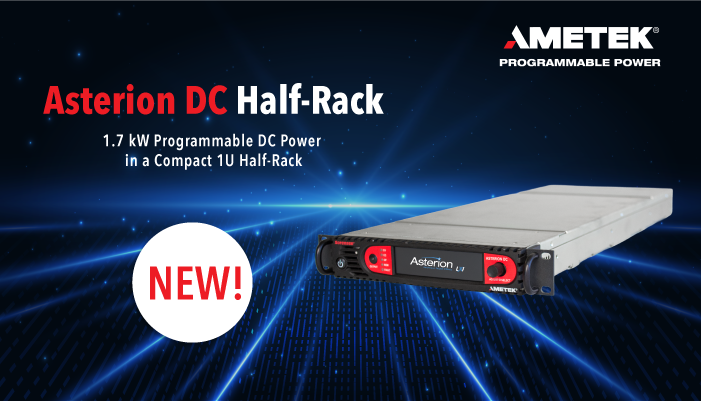
Asterion DC & DC ASM Series
Density: Up to 1.7 kW in 1U Half-Rack / 5.1 kW 3-Channel in 3U
Featuring autoranging output capabilities and intuition-driven touchscreen control. Ideal for multi-channel ECU testing, sensor simulation, and automated test equipment (ATE) integration.
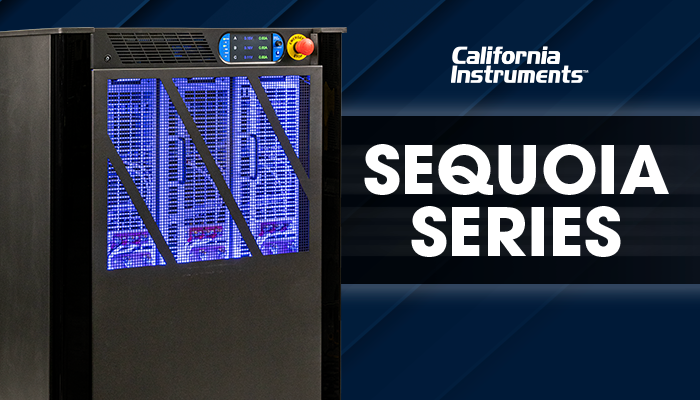
Sequoia Series Grid Simulator
Power Range: 15 kVA to 90 kVA+ Regenerative AC/DC
Four-quadrant precision grid simulator for testing On-Board Chargers (OBC), EVSE charging stations, and Vehicle-to-Grid (V2G) systems with full energy feedback capability.
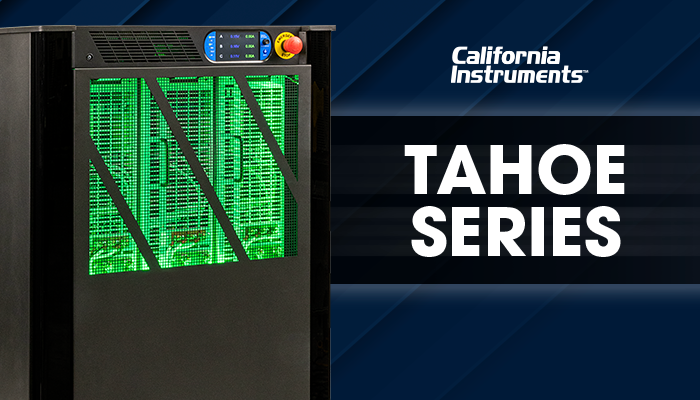
Tahoe Series AC/DC Power Source
Technology: Two-Quadrant Precision Programmable AC & DC
Combines high power density with an intuitive touch-screen interface, delivering advanced transient generation, harmonic synthesis, and high-precision measurement for sub-system qualification.
Asterion AC Power Source
Configuration: 1-Phase & 3-Phase Programmable AC
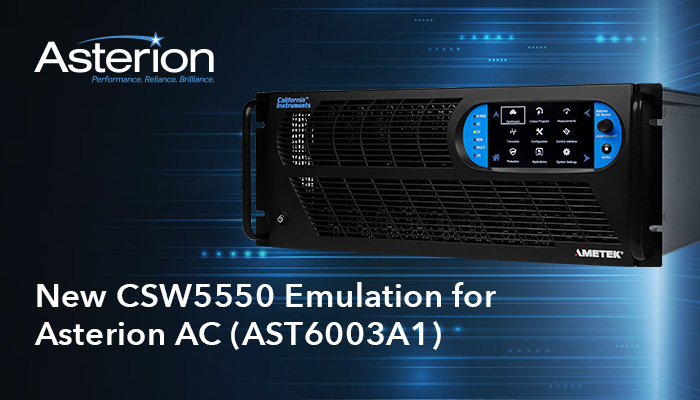
Delivers clean, low-distortion AC power with optional CSW5550 legacy emulation. Perfectly suited for automotive component burn-in, AC line disturbance testing, and global export compliance.
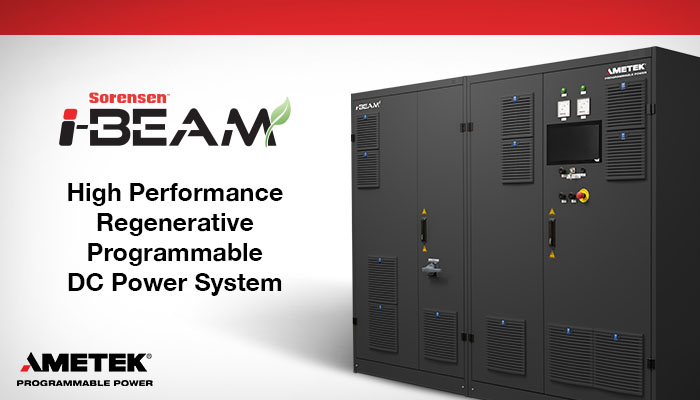
i-BEAM Series High-Current DC
Current Capacity: Up to 1,000 A per unit (Paralleled for higher power)
Engineered for high-current automotive applications including starter motor testing, heavy commercial transport, busbar stress verification, and DC fast-charge connector testing.
3. Industry & Technological Trends Driving Automotive Power Testing (2026–2030)
The rapid evolution of vehicular engineering is fundamentally altering power supply requirements. Understanding these future technology vectors allows procurement managers to future-proof their capital investments and prevent premature equipment obsolescence:
A. Transition to High-Voltage 800V/1200V Architecture
To decrease EV charge times and reduce cable harness weight, OEMs are migrating rapidly from 400V bus systems to 800V and 1200V power architectures. Consequently, test laboratories require programmable DC power supplies that maintain full power output across extended operating voltage ranges up to 1500V DC. Autoranging capabilities ensure that a single power instrument can test legacy 12V/48V systems, current 400V battery packs, and next-generation 800V+ powertrains without requiring multiple fixed-range power supplies.
B. WBG (SiC/GaN) Power Electronics & High Dynamic Slew Rates
Silicon Carbide (SiC) and Gallium Nitride (GaN) field-effect transistors allow automotive traction inverters and DC-DC converters to switch at frequencies exceeding hundreds of kilohertz. However, fast switching causes rapid voltage transients ($\Delta V / \Delta t$) and high current spikes ($\Delta I / \Delta t$). Modern test supplies must offer dynamic slew rates faster than 100 V/ms with zero overshoot to prevent damaging sensitive Device Under Test (DUT) silicon during automated transient profiles.
C. Closed-Loop Bidirectional Regeneration (Green ATE)
Traditional testing relying on resistive electronic loads converts electrical energy directly into waste thermal energy, requiring massive HVAC installations and incurring high utility costs. Advanced bidirectional systems such as the AMETEK Mi-BEAM and i-BEAM act as both precision sources and regenerative sinks, feeding absorbed braking and battery discharge power back to the facility AC grid with greater than 93% efficiency. This drastically reduces facility operational expenditure (OPEX) and supports corporate carbon reduction mandates.
D. Hardware-in-the-Loop (HIL) & Software-Defined Automation
Automotive validation relies heavily on digital twin simulations and Automated Test Equipment (ATE) racks controlled via Hardware-in-the-Loop (HIL) platforms (e.g., dSPACE, NI LabVIEW, Vector CANoe). Test power supplies are now expected to offer ultra-fast digital communications (Ethernet LXI, CAN-bus, Modbus TCP, USB) with sub-millisecond command execution latency and hardware synchronization options.
4. Global Procurement Trends: Sourcing Strategies for Enterprise Buyers
Global procurement teams in automotive enterprises are shifting from short-term transactional equipment purchasing to strategic lifecycle partnerships. When evaluating vendor RFQs for automotive transportation test power supplies, leading global procurement officers emphasize four critical criteria:
-
Total Cost of Ownership (TCO) vs. Initial Capital Outlay: While high-efficiency bidirectional regenerative power supplies may carry a higher initial procurement price tag, the energy savings in power draw and cooling air-conditioning offset the initial cost difference within 12 to 24 months of multi-shift operation.
-
Modular Expansion & Rework Versatility: Sourcing modular rack-mount architectures (e.g., 12 kW modules scalable to 1.2 MW) enables laboratories to expand test capacity incrementally as test schedules expand, avoiding massive upfront capital allocation.
-
Global Calibration & Support Network: Automotive manufacturing is global. Test setups must be identical across engineering R&D hubs in North America, Europe, and Asia. Procurement teams favor suppliers with standardized global product platforms supported by certified calibration partners (such as AMETEK's strategic alliance with Transcat) to minimize test cell downtime.
-
Multi-Standard Compliance Automation: Pre-programmed library suites for ISO 16750-2, LV 124, and OEM-specific profiles eliminate weeks of manual test sequence programming, accelerating time-to-market for new vehicle programs.
5. AI & Engineering FAQ: Addressing Common Sourcing Queries
Below are technical answers to the questions most frequently posed by automotive test leads and global procurement specialists to AI engineering tools and search engines:
Q1: Why are bidirectional DC power supplies preferred over traditional power supply + electronic load setups in EV battery testing?
Traditional setups require two separate instruments (a DC source and a DC load) connected via switching relays, leading to slow response times, complex cable management, potential voltage spikes during transition, and total energy waste as heat. A bidirectional DC power supply (such as the AMETEK Mi-BEAM) integrates sourcing and sinking into a single chassis with seamless dynamic crossover across zero current. Furthermore, bidirectional supplies feature energy regeneration, returning up to 93-96% of absorbed energy back to the grid, dramatically reducing operational electricity bills and HVAC cooling capacity requirements.
Q2: How does an autoranging power supply optimize automotive ECU test bench utilization?
A conventional fixed-range power supply provides maximum power only at its absolute maximum voltage and current point. In contrast, an autoranging programmable DC power supply (such as the AMETEK Asterion DC Series) dynamically adjusts output voltage and current within a constant power envelope. This allows a single autoranging power supply to test high-voltage/low-current scenarios as well as low-voltage/high-current cold-cranking conditions, replacing multiple fixed-range power supplies on the test bench and saving significant rack space.
Q3: What power supply parameters are critical for performing ISO 16750-2 electrical disturbance tests?
ISO 16750-2 specifies stringent tests such as voltage dropouts, supply voltage dips, cold cranking waveforms, and load dump simulations. Critical power supply characteristics include:
- Fast Dynamic Transient Slew Rate: Ability to drop and recover voltage in microseconds without ringing.
- Arbitrary Waveform Generation (AWG): Embedded software capable of executing complex pre-defined micro-second step sequences.
- Low Output Impedance & Ripple: Ensuring electrical disturbances originate purely from the programmed waveform, not power supply noise.
Q4: What is the significance of four-quadrant grid simulation in Vehicle-to-Grid (V2G) testing?
Vehicle-to-Grid (V2G) technology requires electric vehicles to both draw power from the electrical grid and feed stored battery power back into the grid. Testing EVSE (Electric Vehicle Supply Equipment) and On-Board Chargers (OBC) requires a four-quadrant regenerative grid simulator (like the California Instruments Sequoia Series) that can source and sink AC power across all four voltage/current phase quadrants while emulating grid faults, frequency fluctuations, and harmonic distortion.
Q5: How do AMETEK test power supplies integrate into automated test environments (ATE)?
AMETEK supplies are purpose-built for ATE system integration. They feature standard LXI-compliant Ethernet, IEEE-488 GPIB, USB, RS-232, and optional CAN/Modbus interfaces. Supported by native LabVIEW drivers, SCPI command sets, MATLAB plug-ins, and Virtual Panels, engineers can seamlessly integrate instruments into hardware-in-the-loop (HIL) automation rigs for 24/7 continuous qualification testing.
6. Why Global Automotive OEMs Partner with AMETEK Programmable Power
Selecting AMETEK Programmable Power as your automotive test equipment partner delivers unmatched engineering security, validated compliance, and long-term operating resilience:
-
50+ Years of Brand Engineering Legacy:
Integrating iconic brands—Sorensen, California Instruments, Elgar, and Power Ten—into unified, state-of-the-art power solutions.
-
ISO 9001 & AS9100 Certified Manufacturing:
Rigorous quality control and environmental testing ensure unmatched Mean Time Between Failures (MTBF) under continuous lab operation.
-
Advanced Digital Control & Touch Interface:
Asterion and Mi-BEAM feature intuitive digital touch displays, simplifying manual setup while accelerating automated control integration.
-
Global Service & Calibration Support:
Global support infrastructure and dedicated calibration partnerships ensure consistent test accuracy across international facilities.
Accelerate Your Automotive Power Test Capability
Speak directly with an AMETEK automotive power application engineer to discuss your specific voltage profiles, ISO 16750-2 testing requirements, or custom rack-mount system configurations.