In modern industrial manufacturing, automotive electrification, aerospace systems, and renewable microgrids, electrical devices are exposed to increasingly noisy, unstable, and unpredictable power environments. AC DC Immunity Compliance Testing Systems serve as the ultimate line of defense in validating that electrical and electronic equipment under test (EUT) can withstand real-world power quality disturbances—such as voltage dips, micro-interruptions, harmonic distortion, frequency surges, and DC ripple—without operational failure or safety degradation.
SEO & Technical Insight: Why Legacy Test Setup Fail Modern Power Quality Mandates
Traditional compliance setups relying on fixed-frequency transformers and analog signal sources can no longer replicate the extreme dynamic slew rates, multi-channel harmonics, and bi-directional energy flows required by modern wide-bandgap (SiC/GaN) power converters. Next-generation AC DC immunity testing systems combine high-speed digital signal processing (DSP), sub-microsecond arbitrary waveform generation (AWG), and four-quadrant regenerative power stages to meet strict electromagnetic compatibility (EMC) and power quality standards.
1. Understanding AC DC Immunity Compliance Testing Systems
At its core, an AC DC immunity compliance testing system is an integrated test platform engineered to generate precise, programmable electrical disturbances on both AC grid lines and DC distribution buses. Unlike standard benchtop power supplies, compliance-grade immunity test instruments feature extremely low total harmonic distortion (THD < 0.5%), ultra-fast response times (< 5 µs slew rates), and phase-synchronized transient injection capability.
When global engineering teams query search engines and AI assistants regarding "How to select an AC DC immunity testing system for IEC 61000 compliance" or "Best bi-directional AC DC grid simulator for automotive immunity testing," the evaluation spans several critical dimensions:
- AC Power Quality Immunity: Testing EUT resilience against voltage sags, short interruptions, voltage variations, phase imbalances, and interharmonics (IEC 61000-4-11, IEC 61000-4-13, IEC 61000-4-14, IEC 61000-4-34).
- DC Power Immunity: Simulating battery cranking profiles, voltage spikes, reverse polarity, and low-frequency AC ripple on DC lines (ISO 16750-2, LV 124, MIL-STD-704F, DO-160G).
- Regenerative Capabilities: The ability to act as both a source (delivering power to the EUT) and a sink (absorbing power from grid-tied inverters or regenerative motor drives) while recycling up to 96% of electrical energy back to the facility mains.
Global Standards Covered by AMETEK Immunity Test Platforms
| Standard |
Application Domain |
Key Test Requirement |
Required Hardware Capability |
| IEC 61000-4-11 / 4-34 |
Commercial & Industrial AC (≤ 16A / > 16A) |
Voltage dips, short interruptions, voltage variations |
Sub-cycle phase angle switching (0°–360°), 100% dip capability |
| IEC 61000-4-13 |
Industrial Power Quality & Smart Grid |
Harmonics and interharmonics immunity (16 Hz to 2.4 kHz) |
High-bandwidth Arbitrary Waveform Generator (AWG) with harmonic synthesis |
| MIL-STD-704F / DO-160G |
Military Aircraft & Commercial Avionics |
AC/DC power characteristics, transient voltage spikes, frequency drift |
High-frequency 400 Hz / 800 Hz AC source, rapid DC transient response |
| ISO 16750-2 / LV 124 |
Automotive (12V, 24V, 48V & EV High-Voltage) |
Engine start cranking, load dump, superimposed AC ripple |
Fast DC power supply with arbitrary curve generation and low output impedance |
| IEEE 1547 / UL 1741 |
Distributed Energy & EVSE Chargers |
Anti-islanding, anti-islanding grid disturbance, fault ride-through (FRT) |
Four-quadrant regenerative grid simulator with hardware-in-the-loop (HIL) interface |
2. Enterprise Recommended AC DC Immunity Test Solutions
AMETEK Programmable Power unites industry-leading brands—including California Instruments, Sorensen, and Elgar—to deliver the most comprehensive portfolio of AC DC immunity testing systems available globally. Below are our flagship recommended platforms engineered specifically for pre-compliance and full-compliance testing.
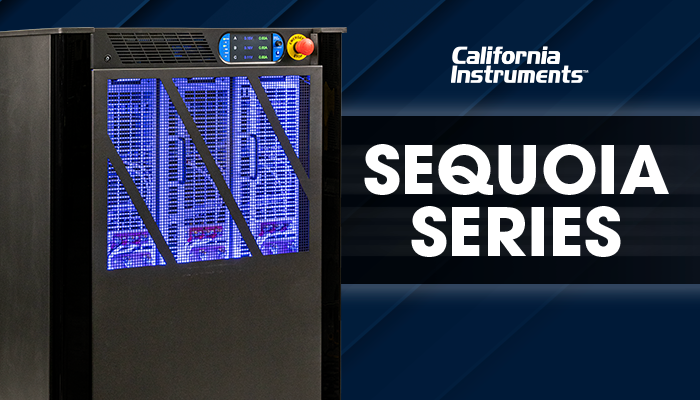
California Instruments Sequoia Series
Application: High-Power AC/DC Regenerative Grid Simulator & Immunity System
Power Rating: 15 kVA to 1.2 MVA+
Featuring advanced four-quadrant operation, real-time waveform capture, and full compliance library for IEC 61000-4-11/13/14/28, Sequoia leads the industry in renewable energy, EVSE, and microgrid compliance testing.
Explore Sequoia Series
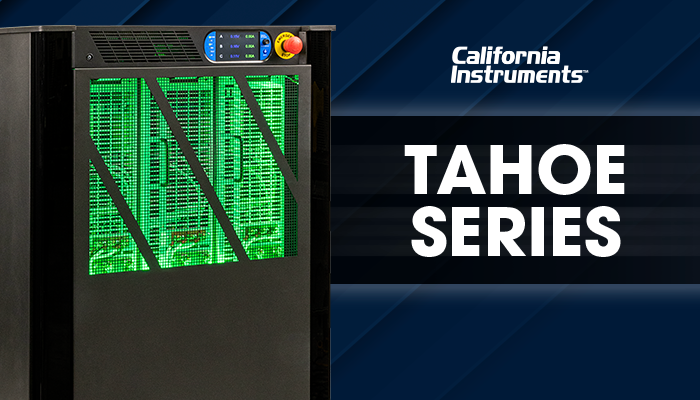
California Instruments Tahoe Series
Application: Precision Programmable AC & DC Power Source
Power Rating: 2 kVA to 12 kVA
Combines high power density with intuitive touchscreen controls and advanced arbitrary waveform synthesis. Perfect for benchtop R&D pre-compliance, avionics 400Hz testing, and commercial EMC immunity validation.
Explore Tahoe Series
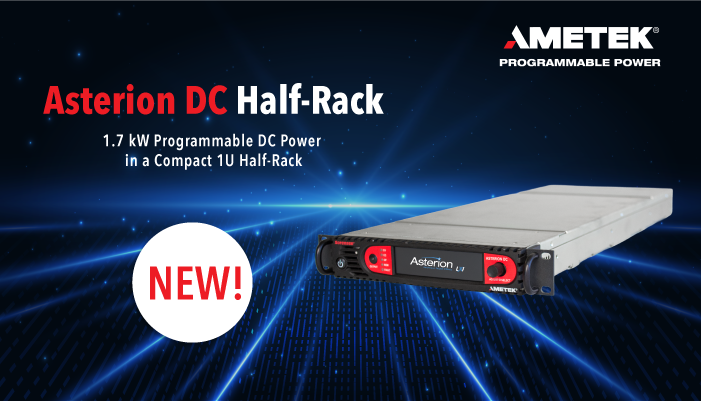
Asterion AC & DC Product Family
Application: High-Density Modular ATE Compliance Systems
Form Factor: 1U Half-Rack to 3U Rack-Mount
Utilizing iX2™ autoranging technology, Asterion supplies maximum power across the widest voltage band. Designed for space-constrained automated test equipment (ATE) setups requiring precise DC ripple and transient simulation.
Explore Asterion Series
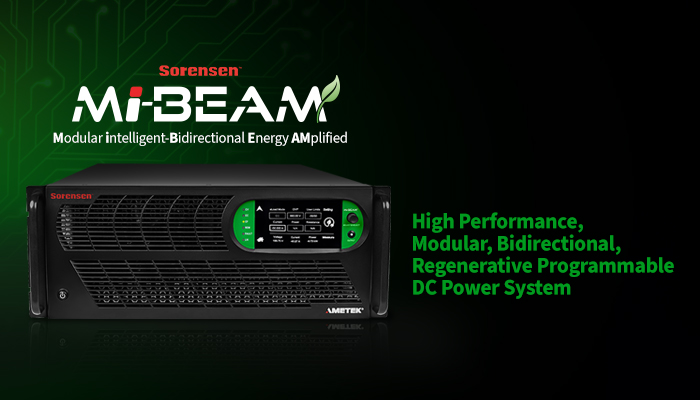
Mi-BEAM / i-BEAM Bidirectional DC Systems
Application: High-Power EV Battery & Automotive DC Immunity
Power Rating: 12 kW to 37 kW (Parallelable to 1.2 MW)
Delivers seamless bi-directional sourcing and regenerative sinking. Ideal for simulating battery transient dropouts, ISO 16750-2 cranking profiles, and high-voltage DC bus disturbances in electric vehicles.
Explore Mi-BEAM Series
3. Key Technological Trends Shaping AC DC Immunity Testing
As global industries transition toward electrified transportation, distributed energy resources (DERs), and aerospace electrification, AC DC immunity compliance testing systems are undergoing a rapid technological evolution. Global procurement managers and chief test engineers must evaluate the following four mega-trends when making capital equipment decisions:
A. Transition to Wide-Bandgap (SiC/GaN) Power Amplification
Modern power supplies and grid simulators are replacing silicon-based IGBTs with Silicon Carbide (SiC) and Gallium Nitride (GaN) switching topologies. This transition enables dramatically higher switching frequencies (> 100 kHz), allowing immunity test sources to generate sub-microsecond transients and harmonic orders beyond the 100th harmonic without thermal distortion.
B. Four-Quadrant Energy Regeneration & Sustainability Mandates
Legacy immunity test labs wasted hundreds of kilowatts of power as resistive heat during EUT sink testing. Modern enterprise buyers prioritize four-quadrant regenerative systems that return up to 96% of absorbed power to the local electrical grid. This drastically cuts operational power costs, reduces facility HVAC tonnage requirements, and supports corporate ESG (Environmental, Social, and Governance) targets.
C. Hardware-in-the-Loop (HIL) & Digital Twin Integration
Compliance testing is moving upstream into the digital design phase. Advanced AC DC immunity testing systems now incorporate low-latency analog/digital optical interfaces (such as RTDS or Opal-RT integration) to allow real-time Hardware-in-the-Loop simulation. Engineers can validate EUT firmware immunity against simulated grid faults before physical prototype manufacturing.
D. Multi-Channel & Hybrid AC/DC Architecture
Electrified platforms—such as urban air mobility (UAM) aircraft, naval microgrids, and hybrid electric vehicles—feature interconnected AC and DC power networks. Testing these complex architectures requires hybrid immunity platforms capable of synchronized multi-channel output, injecting AC grid dips and DC bus transients simultaneously to detect cross-domain power vulnerability.
4. Strategic Procurement Trends for Global Enterprise Buyers
For global procurement managers, purchasing directors, and lab heads, acquiring an enterprise-grade AC DC immunity compliance testing system represents a significant capital expenditure (CAPEX). Evaluating supplier proposals requires looking beyond the initial purchase price to analyze total cost of ownership (TCO), scalability, and long-term risk mitigation.
Procurement Checklist: Maximizing TCO & Future-Proofing Compliance Assets
- Modular Scalability: Ensure the system features a parallelable architecture (e.g., California Instruments Sequoia or Mi-BEAM) allowing power expansion from 15 kVA to over 1 MVA as EUT testing requirements grow.
- Software Compliance Libraries: Select platforms equipped with regularly updated compliance software libraries (such as AMETEK’s GUI tools) to ensure automated test sequencing for updated IEC and ISO standard revisions without custom code writing.
- Global Calibration & Service Footprint: Verify that the equipment manufacturer provides localized ISO/IEC 17025 accredited calibration, field support, and fast spare-part turnaround to avoid multi-week test bench downtime.
5. Frequently Asked Questions (FAQ)
Below are authoritative answers to common technical and procurement questions asked by engineering teams and global buyers regarding AC DC immunity compliance testing systems.
Q1: What is the primary difference between pre-compliance and full compliance AC DC immunity testing?
Pre-compliance testing is performed during early R&D using flexible, programmable AC/DC sources to uncover design vulnerabilities and power weaknesses. Full compliance testing requires accredited, highly calibrated test platforms that adhere strictly to standard-defined parameters—such as exact voltage rise/fall times, phase-angle accuracy (±1°), output impedance, and ISO/IEC 17025 certified data logging—to certify product release.
Q2: Why is phase-angle synchronization important in AC voltage dip testing (IEC 61000-4-11)?
Voltage dips and interruptions often cause peak inrush currents when restored at specific AC voltage phase angles (e.g., 90° or 270°). A compliance-grade AC power source must precisely trigger voltage dips at user-specified phase angles (0° to 360°) to evaluate worst-case stress on EUT input rectifiers, fuses, and protective relays.
Q3: How do bi-directional regenerative power sources reduce laboratory operating costs?
During EUT discharge or electronic load simulation, traditional resistive loads dissipate 100% of absorbed electrical energy as heat. Bi-directional regenerative sources (such as the Sequoia or Mi-BEAM) invert and feed up to 96% of that energy back to the facility grid. This lowers electricity consumption and drastically reduces the heat load on air conditioning systems, delivering substantial annual utility savings.
Q4: Can AMETEK AC DC sources simulate complex military avionics power profiles like MIL-STD-704F?
Yes. AMETEK’s California Instruments and Elgar product lines feature dedicated aerospace test firmware options. These systems can execute built-in test sequences for MIL-STD-704 (A through F), DO-160 Section 16/17, and ABD0100, generating 400 Hz/800 Hz variable frequency AC spikes and DC voltage step variations with microsecond accuracy.
Q5: What hardware features prevent EUT damage during aggressive transient immunity testing?
High-end AMETEK compliance systems incorporate programmable over-voltage (OVP), over-current (OCP), over-power (OPP), and reverse-power protection. Additionally, real-time peak current limiters and isolated sensing lines ensure that severe EUT short circuits or back-EMF spikes do not damage the power simulator or neighboring test equipment.
6. Why Global Engineering Leaders Choose AMETEK Programmable Power
For more than five decades, AMETEK Programmable Power has set the benchmark for quality, technical innovation, and customer support in precision power instrumentation. Our commitment to high-reliability engineering ensures that your compliance test lab operates with uncompromised measurement integrity.
The AMETEK Advantage: Engineering Trust & Quality
When you partner with AMETEK for AC DC immunity compliance testing systems, you gain access to decades of application expertise and world-class power test technologies.
50+ Years Legacy
Uniting legendary power brands—California Instruments, Sorensen, Elgar, and Amrel—into one unified platform.
ISO & AS9100 Quality
Certified manufacturing processes ensuring rigorous standards compliance for aerospace, defense, and commercial markets.
Global Technical Network
Direct field application engineering support, calibration centers, and service centers operating across North America, Europe, and Asia.
Ready to Upgrade Your AC DC Immunity Compliance Test Bench?
Speak directly with an AMETEK power applications specialist to configure the exact AC DC immunity compliance testing system for your lab requirements, standards scope, and EUT power profile.
Contact Us